


Hello, and welcome to this week’s edition of Points & Figures, put together by Kulsum.
The idea is simple: to tell stories about the Indian economy, financial markets and investing through data. Instead of sharing random charts without context, we delve into overlooked datasets to explain shifts and trends you may not otherwise encounter.
To most people, the capital markets are simply stocks. But underneath that familiar surface, the market is changing. Small towns are rapidly taking to mutual funds. SIPs carry more household savings each month. The wealthy are putting more money into PMS and AIFs. Office buildings and highways are becoming tradeable through REITs and InvITs.
There isn’t a single, clean wave of investors rushing into every asset class. In some places, the market is genuinely reaching new participants. In others, the same investor base is committing more money. And there are corners where the capital markets plumbing is being built in the hope that participants will arrive.
These shifts have left their footprint in the data, much of which you can find in SEBI’s latest annual report.
The investor map is changing
Going by mutual fund data, more of India is investing than ever before. India added around 72 lakh unique mutual-fund investors in FY26, taking the total from 5.42 crore to 6.14 crore.
Most of this shift came from outside India’s largest cities. The number of investors in Tier-II cities jumped 37.6%, from 1.03 crore to 1.42 crore over the year. That is now slightly more than the 1.34 crore investors in Tier-I cities. Tier-III locations still account for the largest number overall, at 3.39 crore.
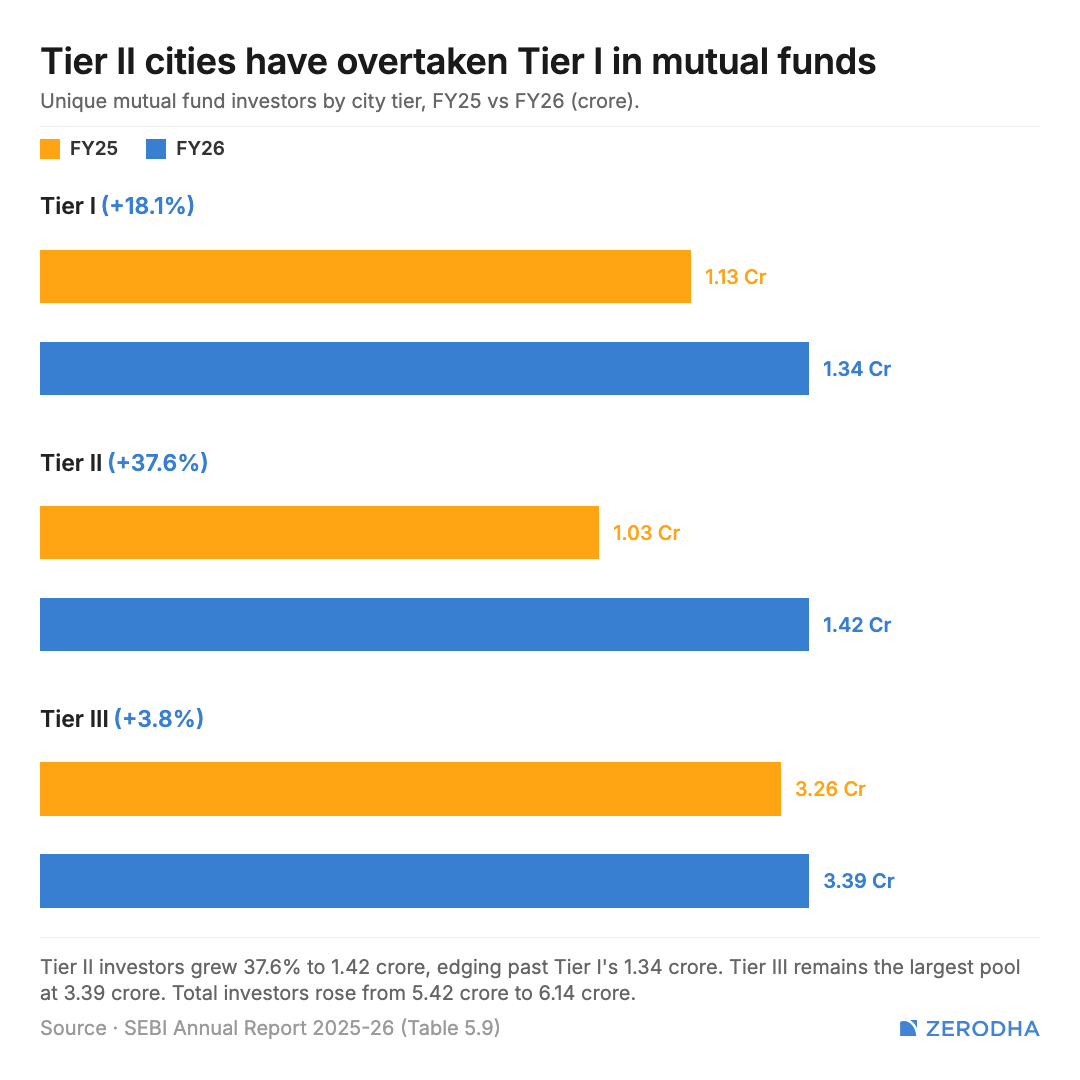
Why? We think digital onboarding and payments have made it possible for one to start investing without going through a bank branch, broker or financial adviser. This ease of access has allowed mutual funds to break out of metro cities.
SIPs got bigger without adding many accounts
The story of SIPs is a little different.
Contributing SIP accounts increased from 10.05 crore to 10.45 crore — growth of only around 4%. Net SIP contributions, however, jumped 25.8%, from ₹1.57 lakh crore to ₹1.97 lakh crore. A net of ₹16,413 crore was added to SIPs every month, on average.
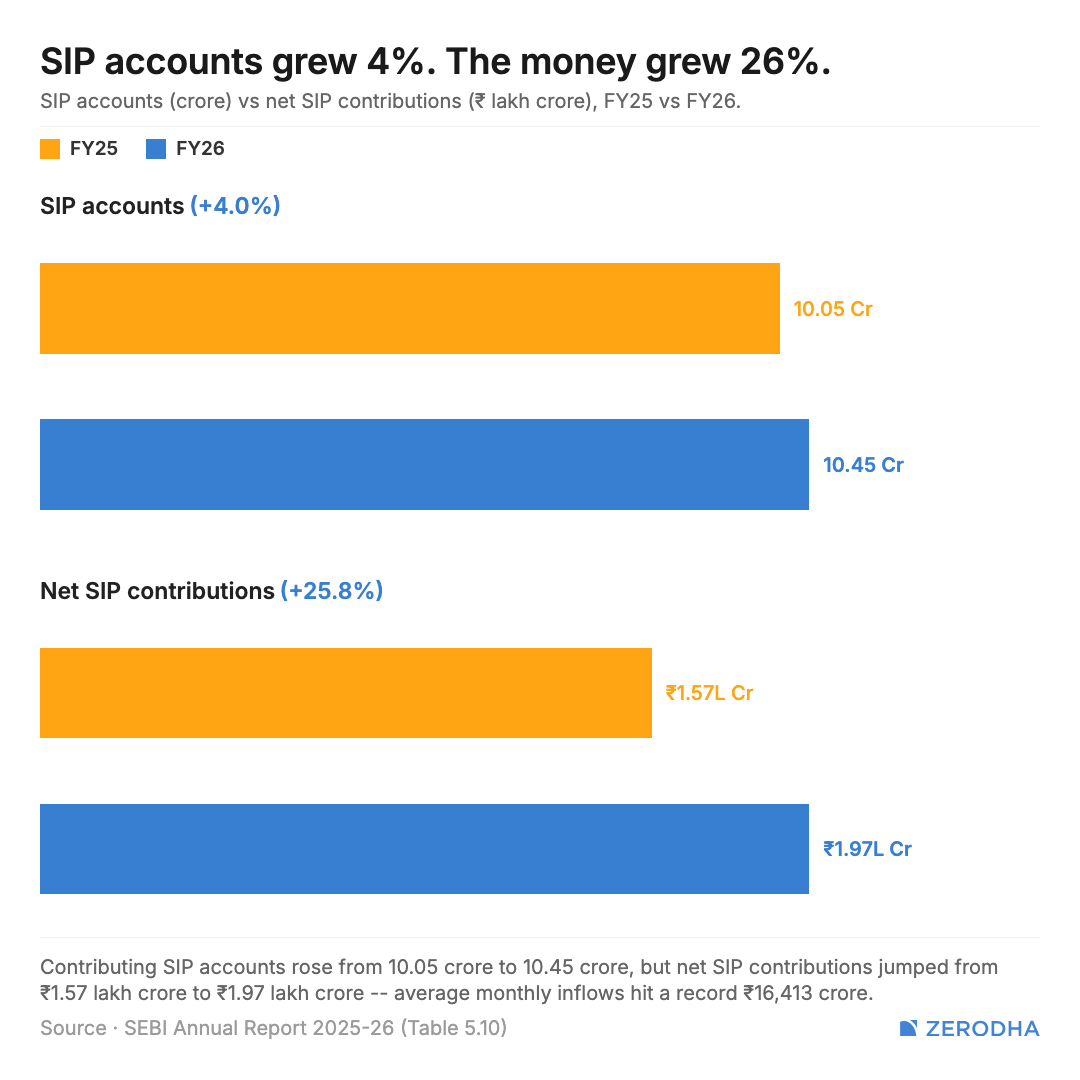
That is, even if the number of people making SIPs hasn’t picked up, among those that do, the habit has grown deeper. This is good for the markets. SIPs are a reliable bridge between household savings and the markets, bringing in money every month, even when things are volatile.
PMS is larger than it first appears
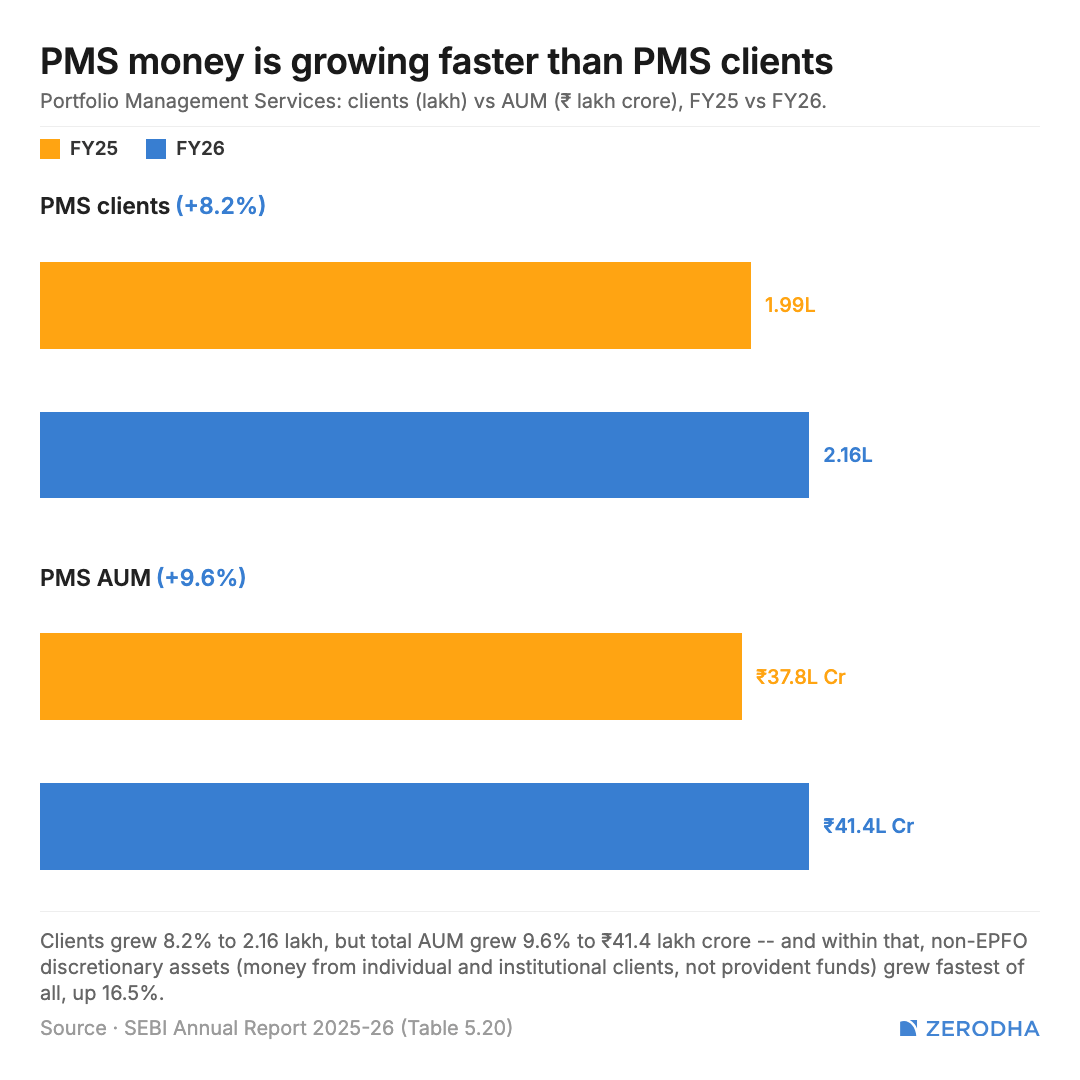
Portfolio Management Services grew in FY26, increasing their clientele by 8.2%, from 1.99 lakh to 2.16 lakh.
Their total assets under management, meanwhile, rose 9.6%, from ₹37.8 lakh crore to ₹41.4 lakh crore. That headline number, however, comes from two very different groups: large retirement pools and a much smaller base of private clients. Around ₹30.1 lakh crore was managed for EPFO and other provident funds. Outside that pool, discretionary PMS assets grew at a dramatic 16.5%, from ₹4.29 lakh crore to ₹5 lakh crore. That is, the money in individual managed accounts has gone up rapidly.
PMS is a high-ticket product. It’s nowhere close to mutual funds in reach. But it’s becoming a large part of the market in its own right.
Private markets are no longer a small corner
If you want to understand India’s private markets, look at its Alternative Investment Funds, or AIFs. These are privately pooled investment vehicles, which come in various “categories”.
Category I includes venture-capital, SME, infrastructure and social-impact funds. Category II includes private-equity and debt funds that generally do not use leverage except for day-to-day needs. Category III can use more complex or leveraged strategies. Category II was the largest part of the ecosystem in FY26.
Across 1,829 registered AIFs, commitments have risen from ₹6.4 lakh crore in FY22 to ₹16.9 lakh crore in FY26. This isn’t the cash these funds have already collected — it’s money investors have committed to give when called on to do so. Of this, ₹7 lakh crore has actually been raised.
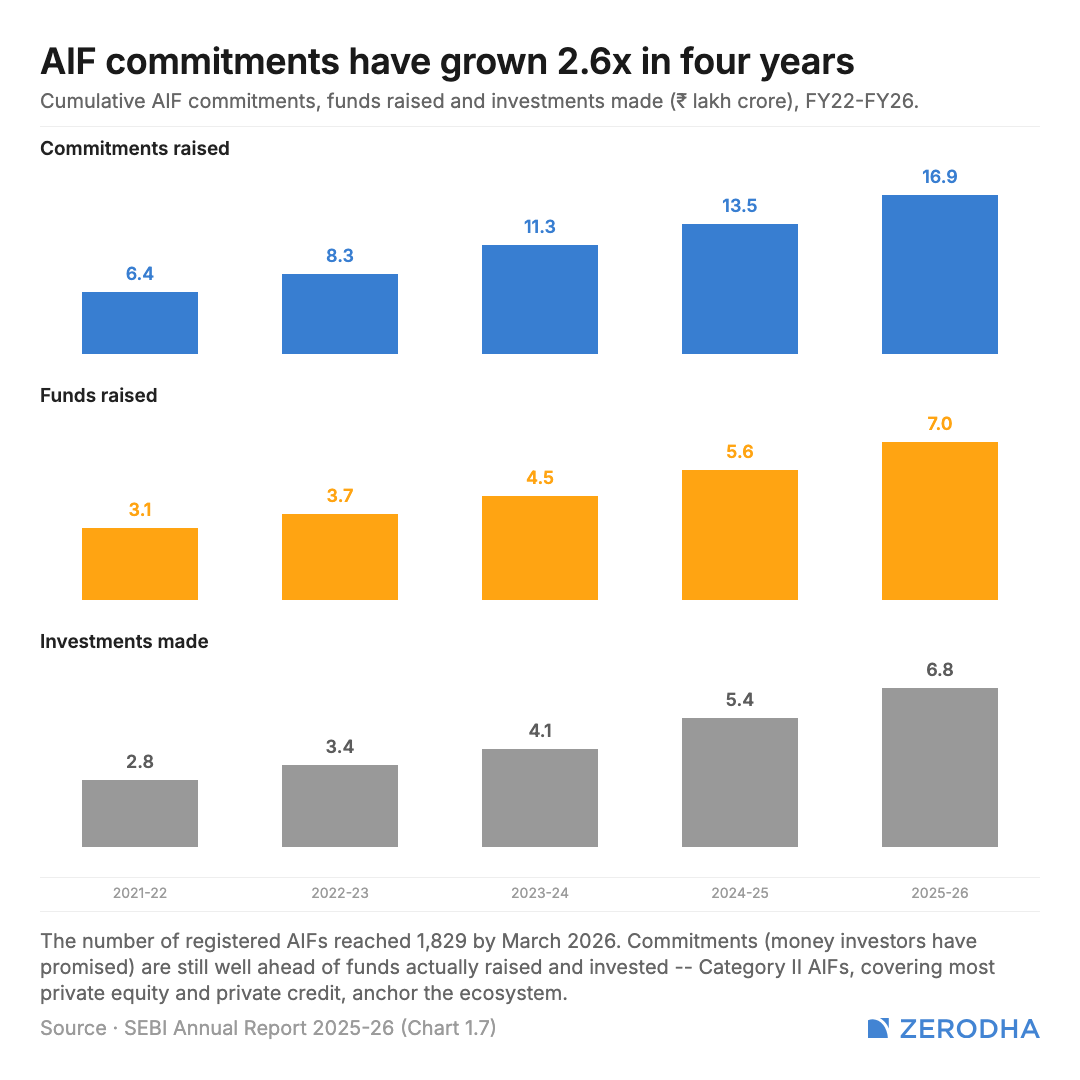
Even so, the market is now large enough to play a serious role in financing businesses outside public exchanges.
Buildings and highways are becoming financial products
For most Indian households, investing in real estate usually means something like buying a house or a plot. The markets, however, have opened up a new option — REITs and InvITs break much larger income-generating assets into tradeable units, making it possible to invest without owning or managing a property or project directly.
REITs largely hold commercial properties such as offices. InvITs hold infrastructure such as roads, power networks and renewable-energy assets. REIT AUM increased from ₹1.63 lakh crore to ₹2.38 lakh crore in FY26. SM REIT (Small and Medium Real Estate Investment Trusts) AUM, more than doubled from ₹359 crore to ₹853 crore, although the segment remains tiny.
REIT fundraising nearly doubled to ₹9,300 crore. In part, this follows a widening of these products. REITs were reclassified as equity for mutual-fund investment from January 2026. Meanwhile, the public-issue process for SM REITs was simplified. That could bring more institutional money into the space while giving smaller real-estate projects a route to market.
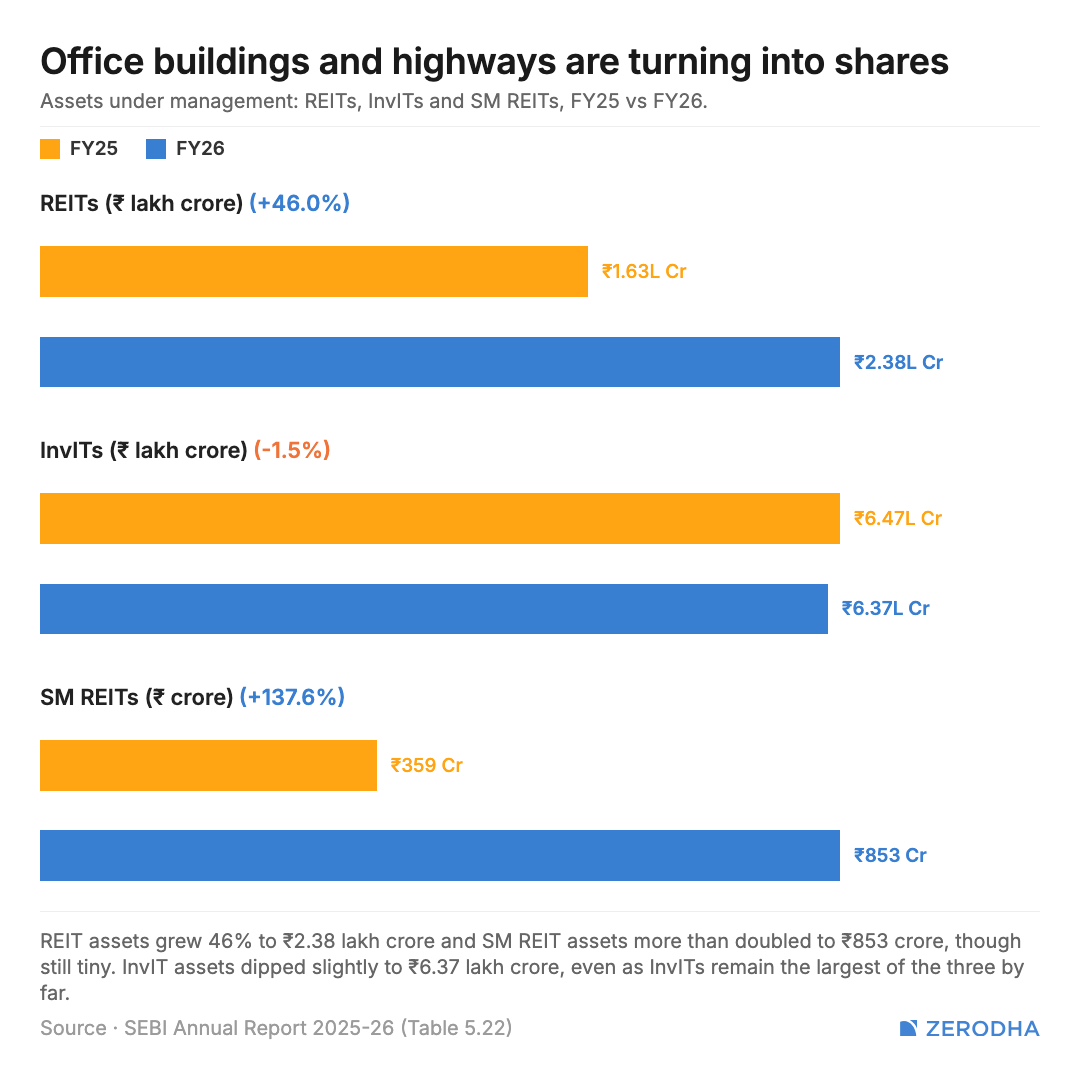
InvIT fundraising, however, lagged slightly, falling 21.3% to ₹21,025 crore.
Smaller companies are finding their way to the exchange
It isn’t just investors who are entering new parts of the market. The range of companies raising money is widening too.
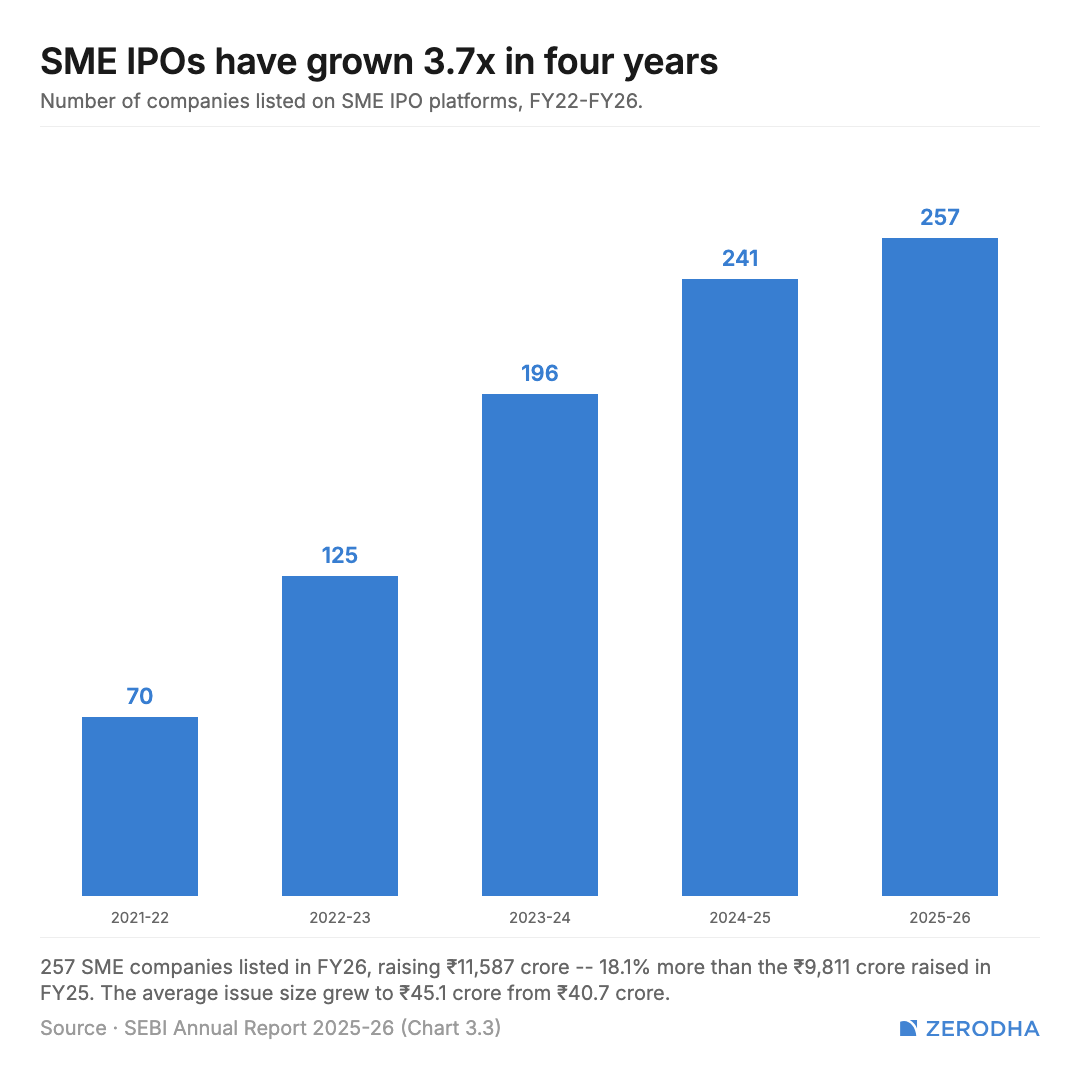
India’s SME platforms hosted 257 IPOs in FY26, up from 70 in FY22. Collectively, these companies raised ₹11,587 crore, 18.1% more than the previous year. Their average issue size also increased from ₹40.7 crore to ₹45.1 crore.
SME IPOs give smaller businesses access to public equity without requiring the size of a mainboard company. They also tend to be more focused on raising money for the business. SEBI’s analysis found that the offer-for-sale share in SME IPOs generally remained between 0% and 27%, while mainboard IPOs regularly had OFS shares above 60% from 2016 onwards. In other words, SME IPOs are more likely to bring fresh money into the company instead of mainly allowing existing owners to sell.
Cities are discovering bonds
For years, municipal bonds seemed like a failed product with no takers.
But FY26 changed the picture. Municipal corporations raised ₹1,756 crore through 14 issues. One year ago, the entire market consisted of one ₹100 crore issue.
Cities must pay for water, transport, sanitation and other infrastructure. For this, they usually depend on their own revenues, state and central government grants, budgetary support and loans. Municipal bonds add another source of long-term funding. They do not replace government budgets, but they can help finance specific projects, in exchange for better accounts, credit ratings and clearer disclosure of how the money will be used.
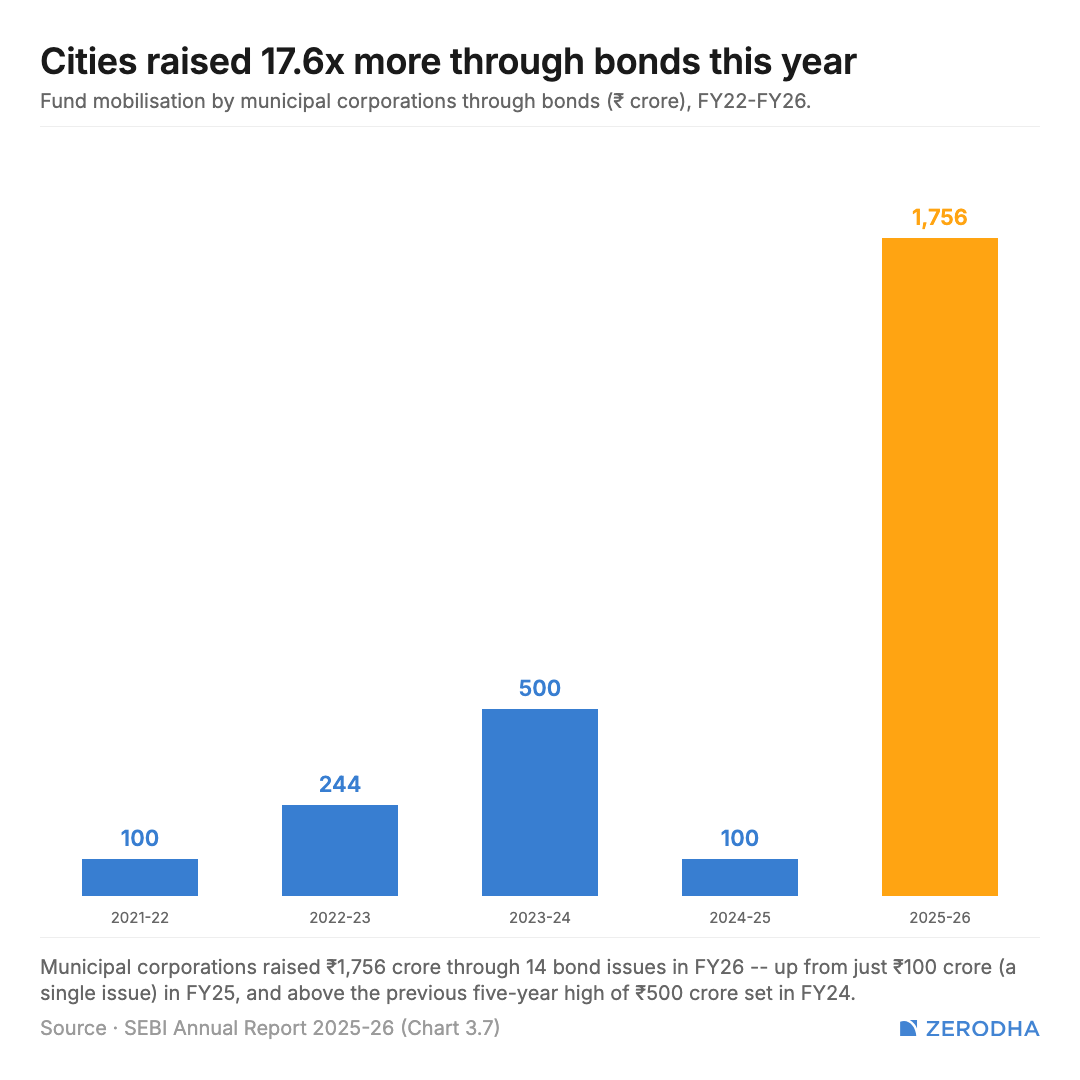
The surge wasn’t automatic. SEBI conducted outreach programmes with urban local bodies and expanded the rating framework for project-backed municipal bonds. The next test is repetition: will cities return to the market regularly, or will FY26 remain one unusually strong year.
Even donations are being given market infrastructure
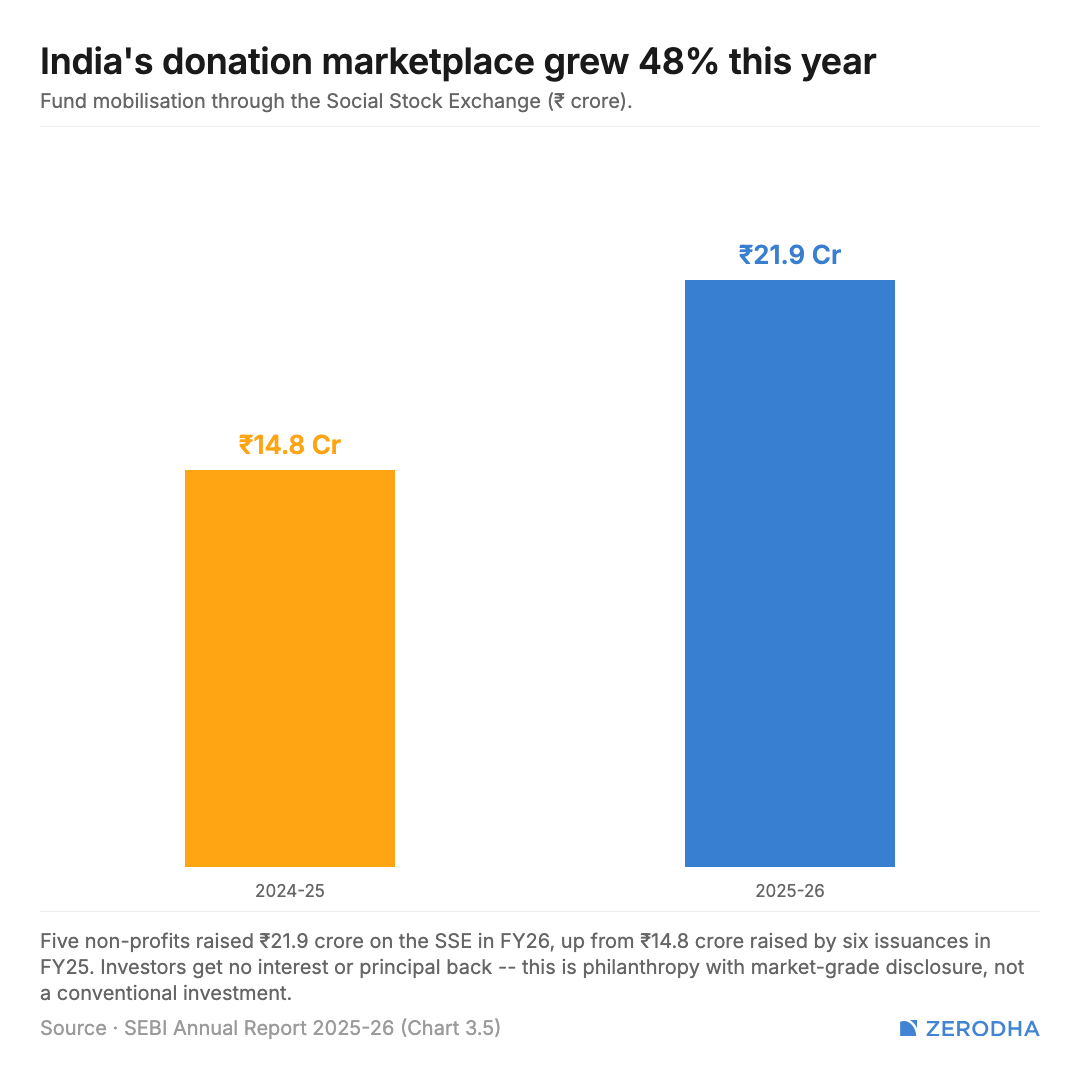
The Social Stock Exchange is the smallest market in this edition, but perhaps the most unusual. These aren’t an investment product in the usual sense. It is closer to philanthropy placed inside a regulated market structure. Here, non-profit organisations use instruments known as zero-coupon, zero-principal securities. Investors provide money for a social programme to these entities, without receiving interest or even their original capital.
In FY26, five organisations raised ₹21.9 crore, compared with ₹14.8 crore raised through six issuances in FY25. For now, it remains an experiment rather than a major funding market. But it shows how far the idea of a securities market can stretch.
Corporate bonds are moving onto more organised rails
Corporate bonds don’t all trade like shares, on an exchange screen. A large part of the market is negotiated between institutions over the counter and then settled through clearing corporations. Some bonds are also transferred off-market through the depositories. When clearing corporation settlements rise, that could reflect both more trading and more activity moving onto formal settlement rails.
In FY26, the value of corporate bonds settled through clearing corporations increased 27.9% to ₹21.2 lakh crore. The number of listed corporate-bond trades settled through them rose much faster, from 11 lakh to 26.8 lakh.
The direction of policy, recently, has been towards opening the market — from a reduced face value for privately placed debt, to exchange-based trading.
Has this worked? Because the number of trades grew much faster than their value, the average transaction became smaller. There clearly have been more frequent, smaller trades. Does this prove retail participation, however? It’s unclear. The report does not identify who made them, and private placements still accounted for 98.8% of corporate-bond fundraising.

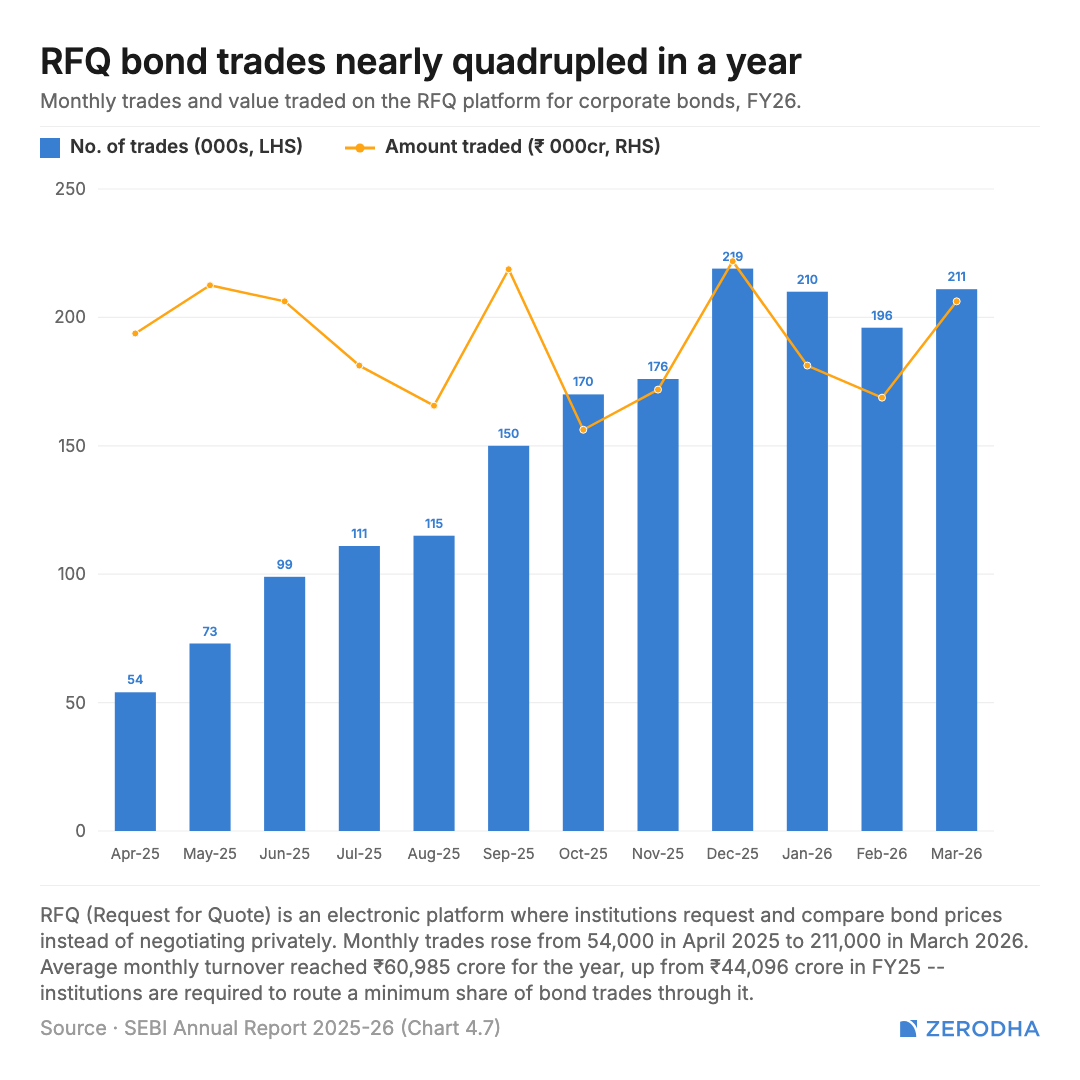
The ‘Request for Quote’ platform is part of the same shift. Instead of completing the entire trade through a private conversation, institutions can request and compare quotes electronically across corporate bonds, commercial paper, government securities and other debt instruments. Such a common electronic platform can improve transparency and price discovery in a market that has long been dominated by bilateral deals.
The use of this platform has grown sharply since its launch in 2020, but this was not entirely organic. Mutual funds, AIFs, portfolio managers, FPIs and brokers are required to execute a specified share of their bond trades through RFQ. This growth, therefore, reflects a regulatory push to put rails in place.
A wider market, but not in one single way
Two different changes emerge from all these charts.
Some pipes are carrying more money, from SIP contributions, to PMS assets. AIFs show a separate shift: private-market capital is becoming larger and more organised. At the same time, new pipes are being opened. Smaller companies are listing, municipalities are issuing bonds, non-profits are raising money on exchanges, and physical assets are being converted into tradeable units.
Not every product has become mainstream. But this is an early sign that India’s capital markets can now accommodate more kinds of money, assets and issuers than they could earlier.