
India’s trade story
Understanding how imports, exports and services shape India's trade story.

Hello, welcome to this week’s edition of Points & Figures. This edition is done by Kulsum & Mridula.
The idea behind this newsletter is simple: to tell stories about the Indian economy, financial markets, and investing through data visualisations. The goal isn’t to send you a bunch of random, out-of-context charts, because pretty much everybody does that already.
Instead, we take large datasets that are often overlooked or under-appreciated and use them to tell stories about trends, shifts, and developments in the Indian economy and markets that you might not otherwise come across. And like everything else we do under Markets by Zerodha, the quality bar remains extremely high.
Every country relies on the rest of the world in one way or another. India is no different. We import things we need to power our homes, run our factories and build our economy. We export the products and services we’ve become good at.
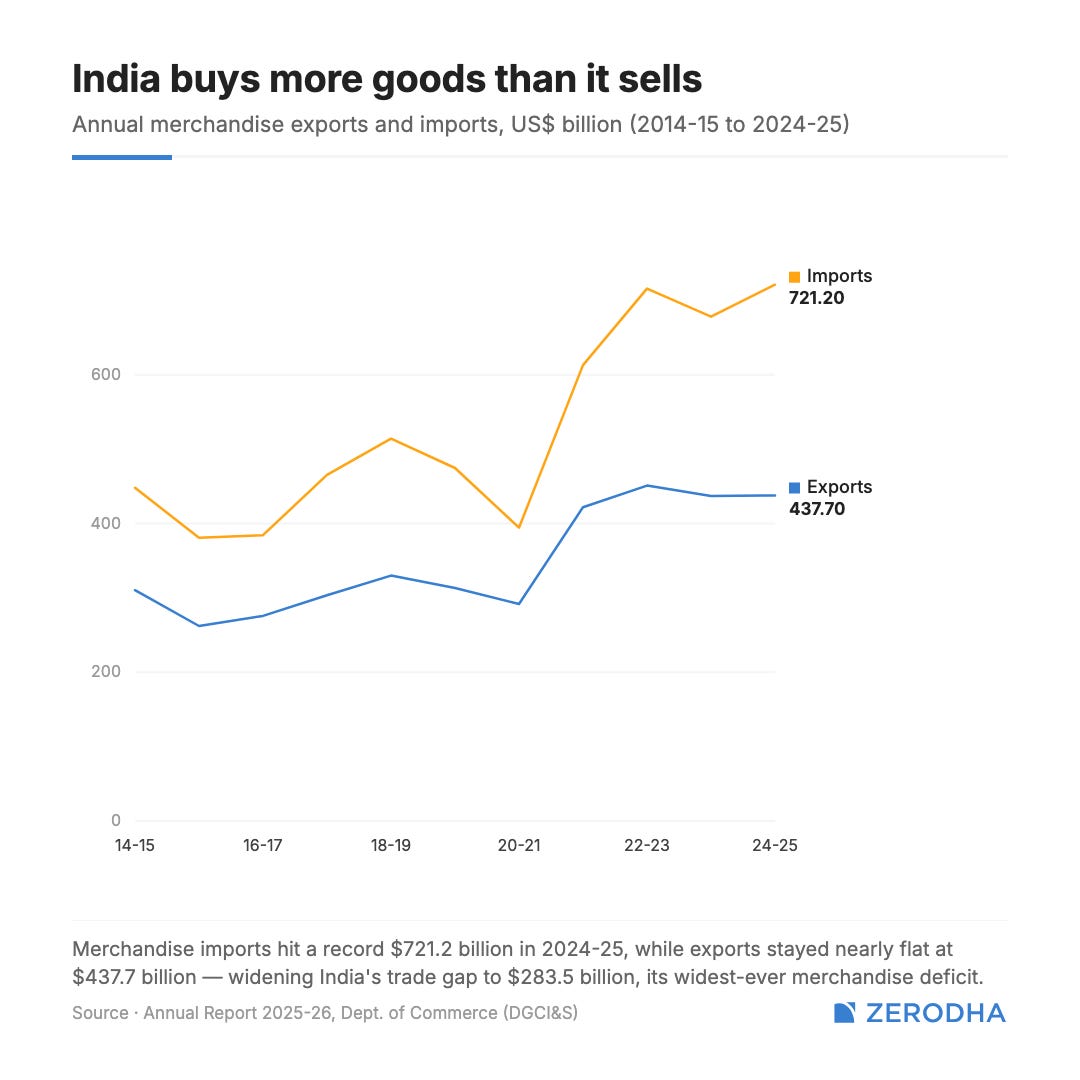
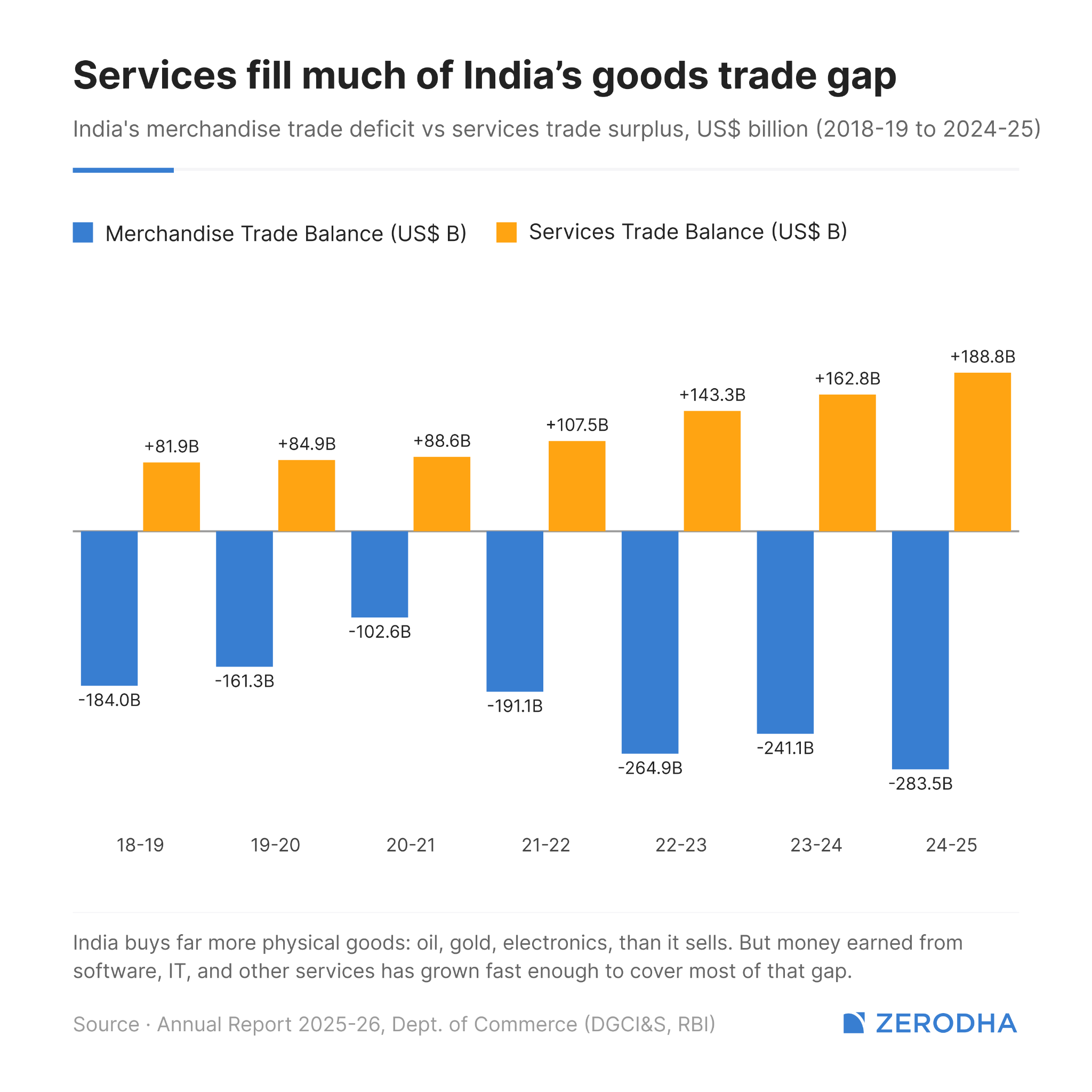
That balance isn’t always even, though. India imports far more physical goods than it exports, resulting in a sizable goods trade deficit. In 2024–25, that deficit reached $283.5 billion.
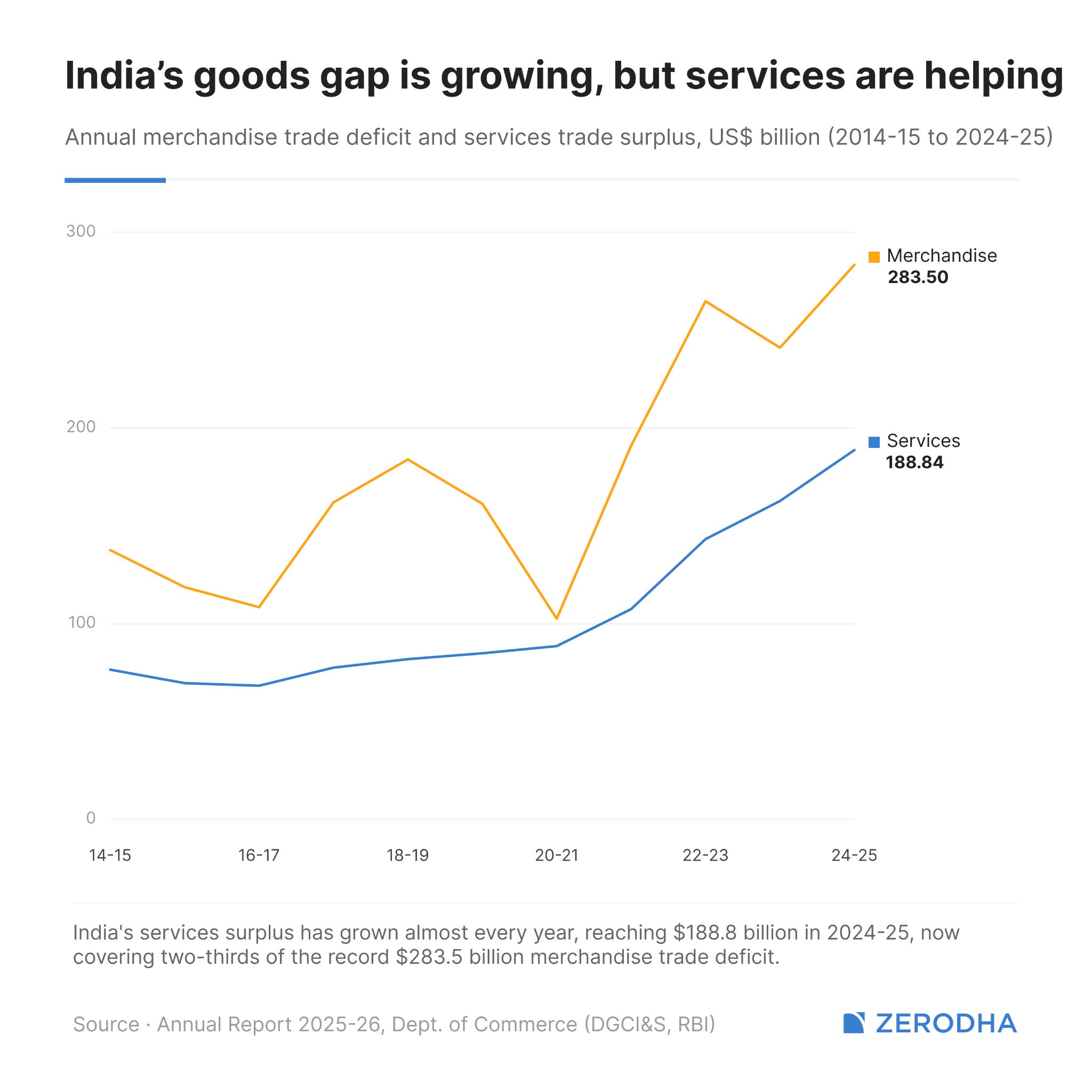
But goods are only one side of India’s trade story. In services, we regularly see a surplus. In FY 2025, it covered nearly $189 billion of that gap.
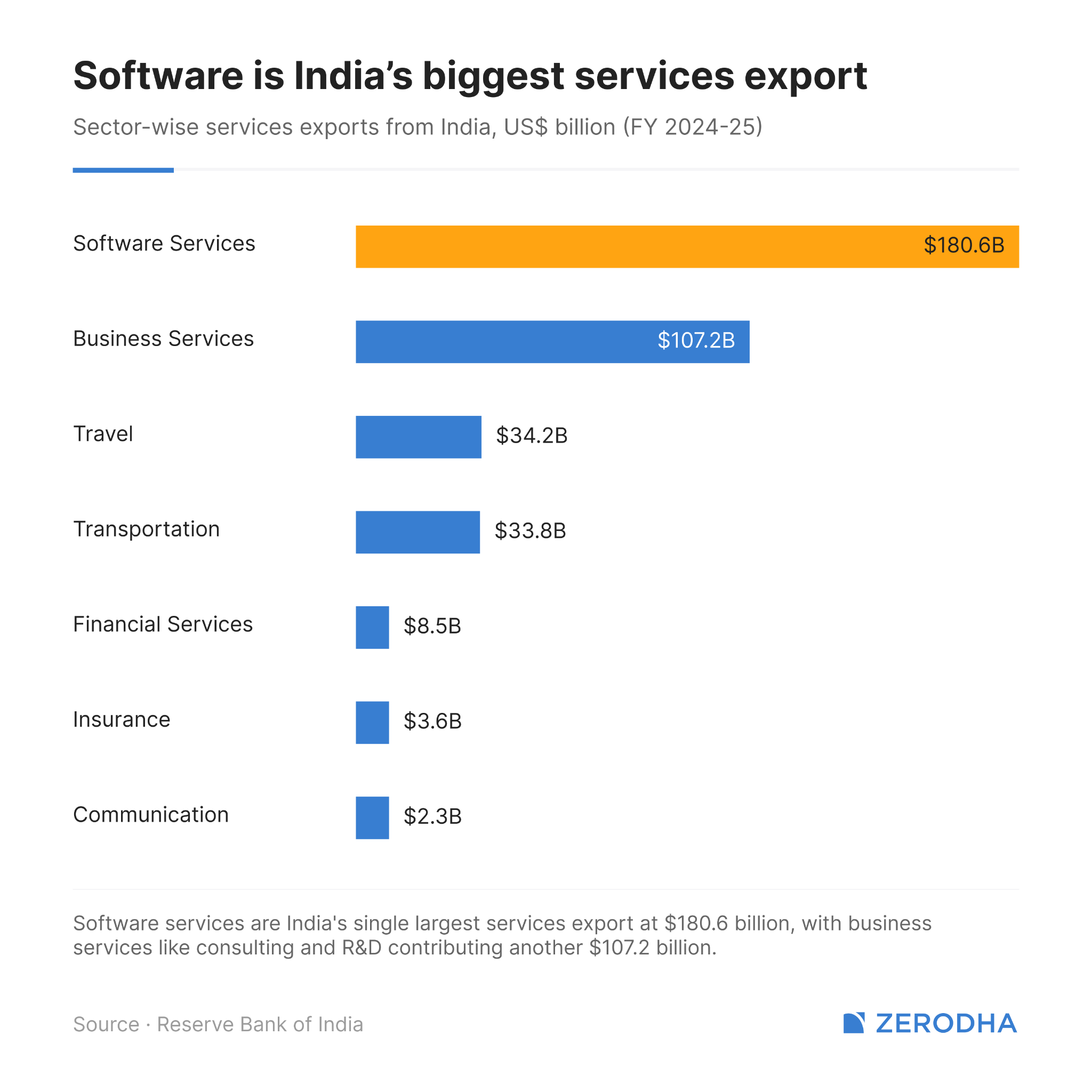
India’s services sector, once synonymous with basic IT and back-office work, has evolved far beyond basic outsourcing. Today, we export everything from software and consulting to financial and engineering services. India’s Global Capability Centres, meanwhile, support the day-to-day operations of multinational companies.
The foreign exchange earned from these exports helps offset a large part of what we lose because of the country’s merchandise (goods) trade deficit.
Why does India import so much?
A large import bill isn’t necessarily a sign of weakness. Every economy imports things it either cannot produce in sufficient quantities or simply finds more efficient to source from elsewhere. Some imports are consumed directly, while others become inputs for businesses and industries. The real question isn’t how much India imports, but what role those imports play in the economy.
Take energy, for example. Crude oil, coal and natural gas power homes, factories and transport systems. India simply doesn’t produce enough to meet domestic demand, making these imports essential.
Then there are imports that help create more economic activity. Electronic components, industrial machinery, chemicals and pharmaceutical ingredients are brought into the country so Indian factories can manufacture finished products, many of which are eventually exported.
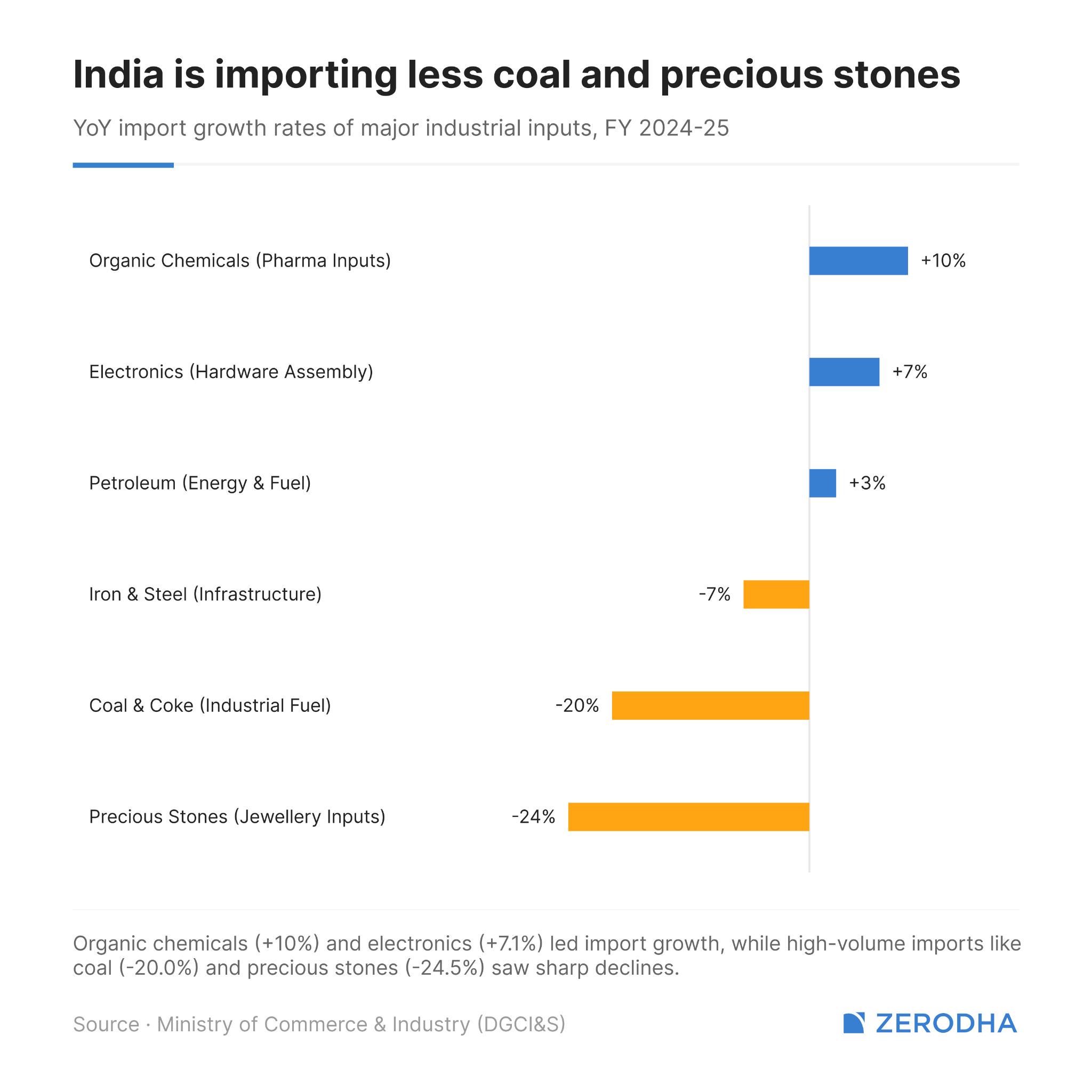
There are a couple of specific things worth noting, here.
For one, our coal imports have declined about 20%. Why is that? We have two guesses. For one, India’s own coal production has increased. Two, a huge portion of electricity generation has shifted from thermal to renewable energy.
It’s also worth noting that our import of precious stones like pearls, precious and semi-precious stones has declined, although the trade data does not attribute a cause, industry reports suggest the decline was likely driven by weaker global demand for natural diamonds and lower purchases of rough stones by Indian processors.
India’s goods exports are changing
India’s merchandise exports have remained broadly unchanged at $437.7 billion in 2024–25. What we sell to the world, however, is slowly changing. India has long been one of the world’s biggest exporters of refined petroleum products, but newer industries are now catching up.
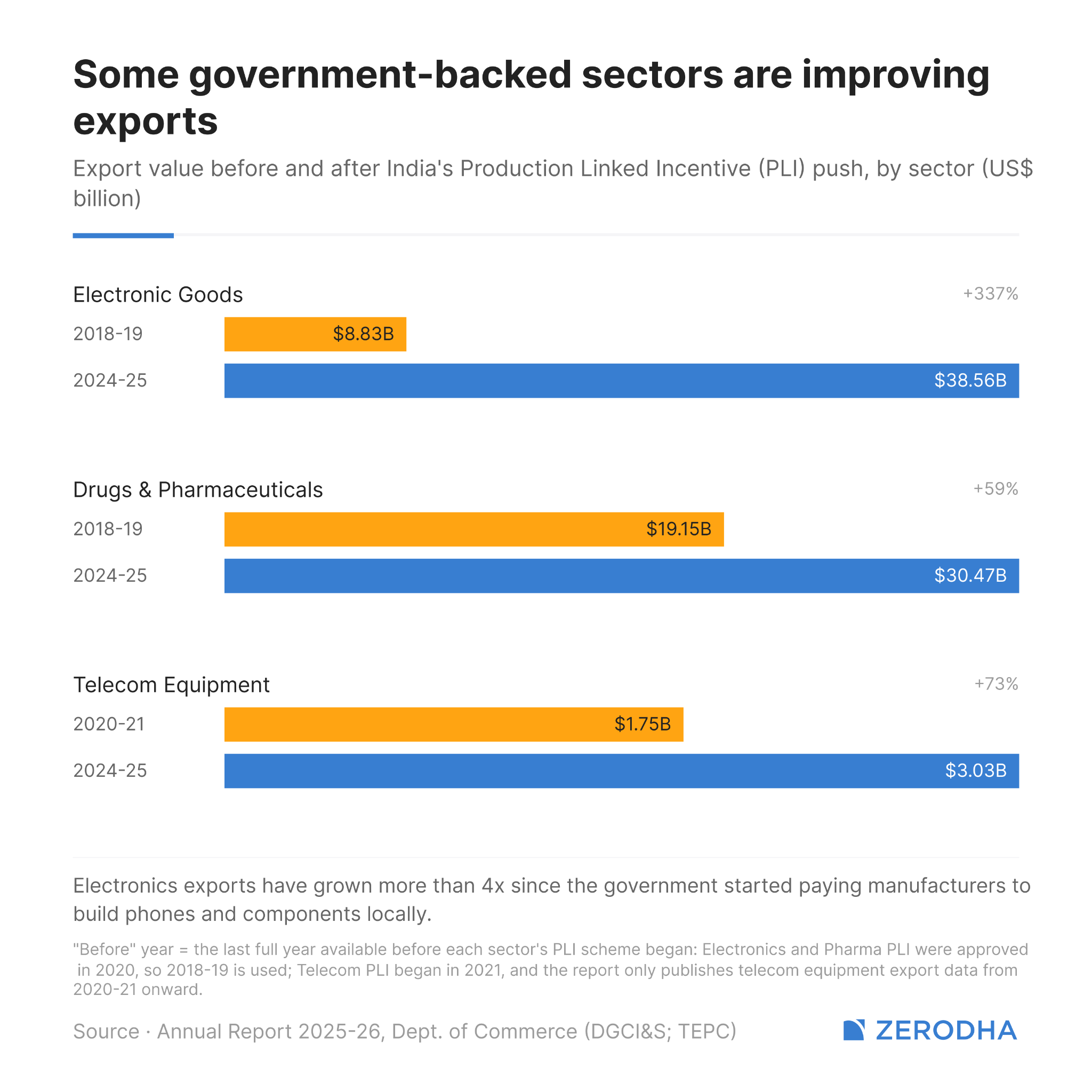
For instance, India now assembles and exports millions of smartphones every year. Many of the chips, displays and other high-value components still come from overseas, but the finished product is assembled and exported from India. As we cement ourselves in such value chains, electronics, engineering goods and pharmaceuticals are steadily becoming a bigger part of our export basket.

Government policies have played a role in this shift, although not all with the same success. Production Linked Incentive (PLI) schemes have helped attract large investments into sectors such as electronics, turning India into one of the world’s largest smartphone assembly hubs. Special Economic Zones (SEZs) and other export-support measures have also encouraged companies to manufacture in India and serve global markets.
Buying from the East, selling to the west
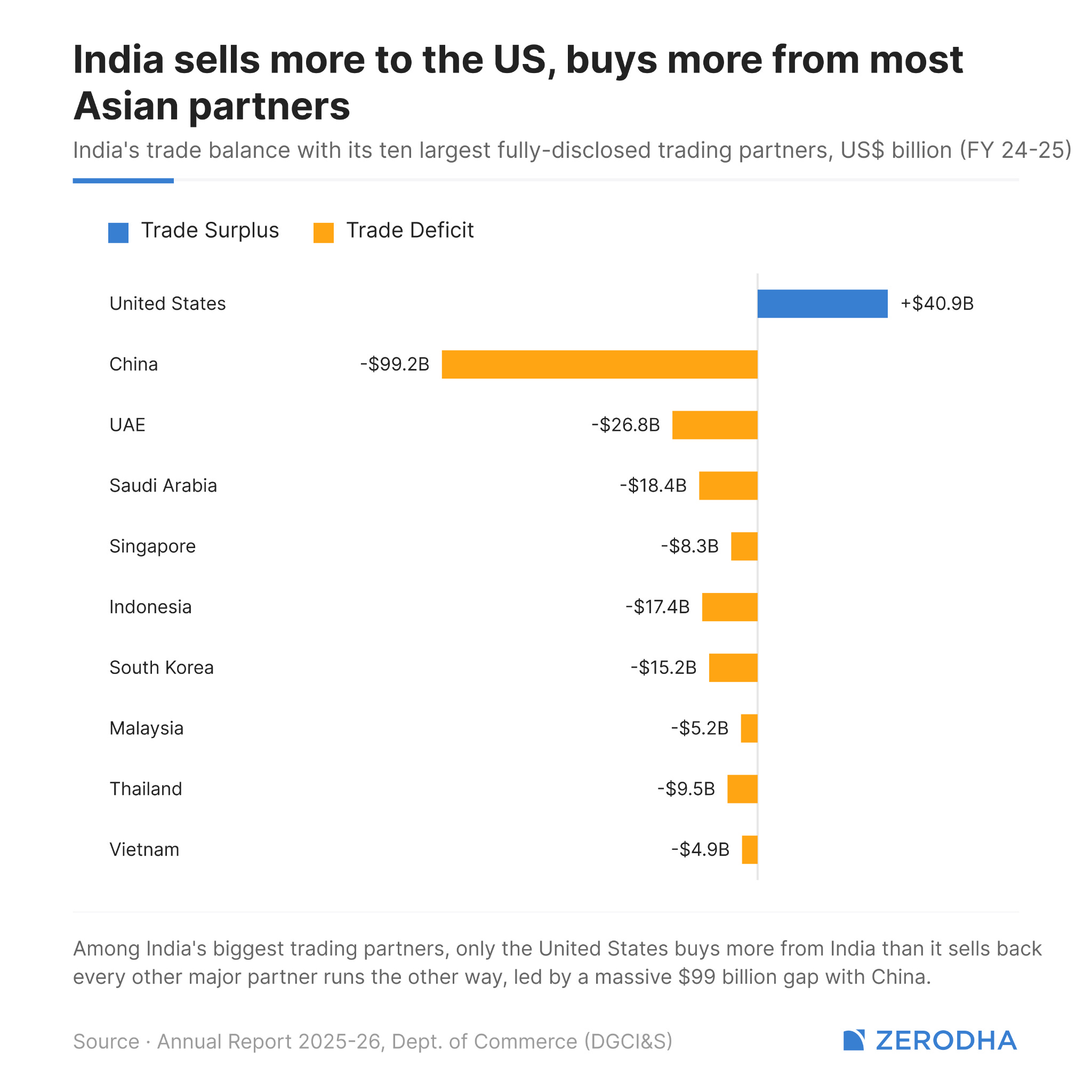
India imports machinery, electronics, chemicals and pharmaceutical ingredients from China, and large quantities of crude oil from Russia. Meanwhile, the US and Europe remain major markets for Indian services, pharmaceuticals and engineering goods.
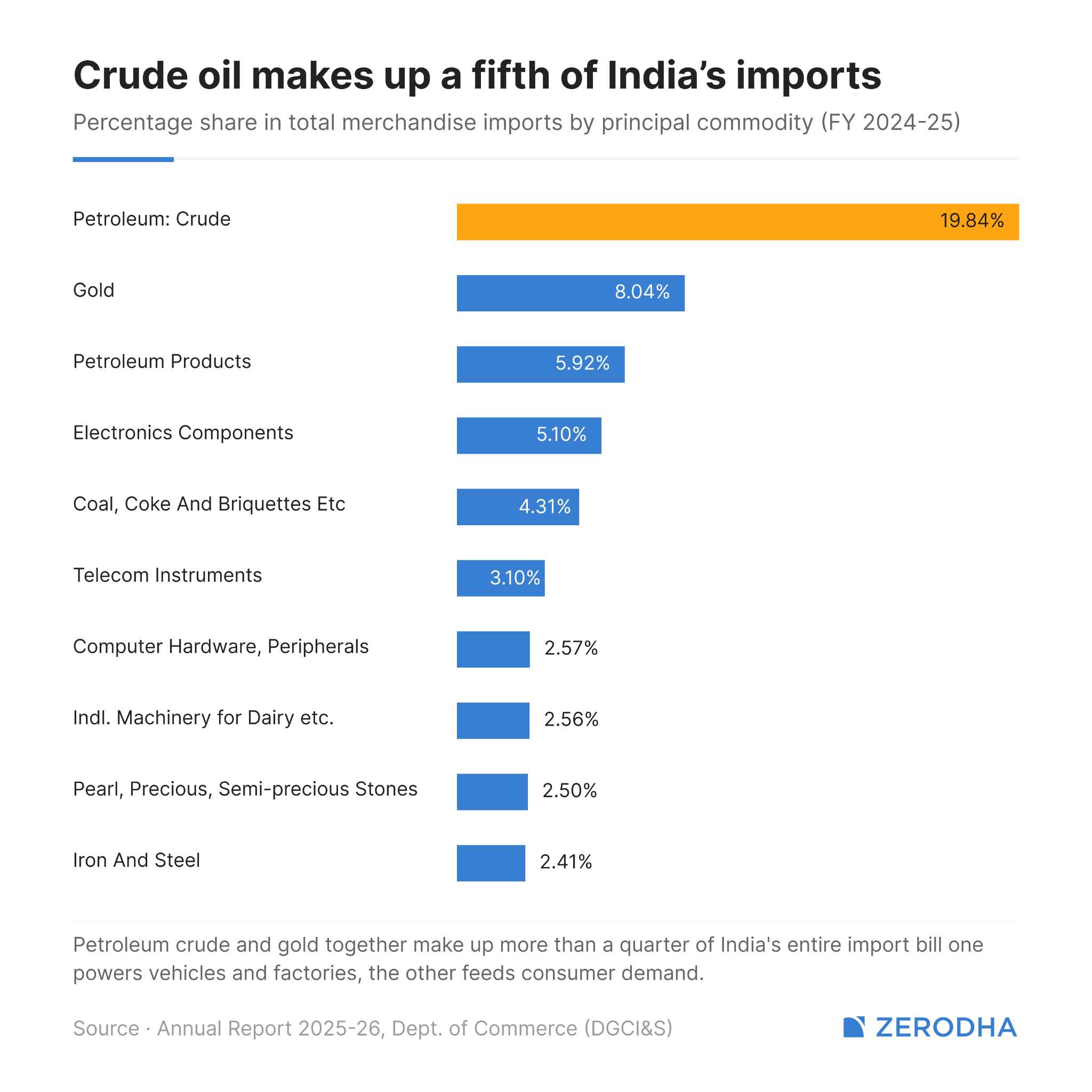
Simply put, India relies on global supply chains for many of its energy needs and industrial inputs, while earning foreign exchange by exporting services and an increasingly diverse range of manufactured goods.
Conclusion
Trade isn’t a scoreboard where a country wins by exporting more and importing less. Every major economy imports what it needs and exports what it does best. India’s imports keep homes powered, factories running and industries supplied, while its exports, from services and refined petroleum to pharmaceuticals, engineering goods and electronics, bring foreign exchange and create jobs.
That said, there is something disproportionate to our persistent trade deficit in goods. There’s a simplistic way of looking at this: that we should cut imports, substituting it with our own produce to remove our dependency. That answer has rarely helped any country rise through the world economy.
It is better to ask: how do we make more of what the world needs? That is one of the defining challenges of the Indian economy, today.
That’s it for the seventh edition.
We hope you enjoyed what we’ve put together for you. This is a new format for us, and we fully understand that there are rough edges and plenty of things that can be improved.
And that’s where your end of the bargain begins.
Please send us your feedback, ideas, suggestions, criticisms, and anything else you think can help make this publication better. Unlike many people who say this as a ritual and then promptly ignore what follows, we genuinely do read the comments, emails, and messages we receive.
Points & Figures is still a work in progress, and we’d love your help in shaping what it becomes.
So let us know what you liked, what you didn’t, what you’d like to see more of, and what you’d like us to do differently. We’ll read it all and use it to make future editions more useful, more insightful, and hopefully a lot more fun.
Until next time.
Great Insights.👍