

Hello, and welcome to this week’s edition of Points & Figures, put together by Kulsum.
The idea is to tell stories about the Indian economy, financial markets and investing through data. Instead of throwing random charts at you, we dig into overlooked datasets to explain shifts and trends you may otherwise miss.
This edition draws heavily on Data For India’s research on judicial pendency. It shows how India’s court backlog has grown, where it sits and how long cases have remained unresolved. We use that work to follow a case from the moment an offence occurs to the years it may spend in court - and to ask what even a backlog of 5.4 crore cases leaves out.
Imagine someone steals your phone.
You report it to the police. If they register an FIR, investigate the theft, find a suspect and file a chargesheet, the case may reach court. Evidence is produced, witnesses are called and a judge decides whether the accused is guilty.
That is the neat version. A case can stall at every step.
The theft may never be reported. The police may not register it. The investigation may go nowhere. Later, a forensic report may be delayed, a witness may not appear or a hearing may be adjourned again and again.
That is why India’s crime data needs care. The National Crime Records Bureau, or NCRB, counts cases recorded by the police. It tells us how many crimes were registered, not how many actually occurred.
A government-appointed committee on crime statistics called the unrecorded part the “dark figure” of crime. People may stay silent because they fear the police, expect nothing to happen or prefer a private settlement. India still does not run a regular nationwide victimisation survey that could estimate what police records miss.
A state with more recorded crime may therefore be more dangerous, better at registering complaints, or both. A low number can mean safety. It can also mean that people have stopped expecting the system to help.
How the queue keeps growing
India’s judiciary has three broad levels. District and subordinate courts are where most civil disputes and almost all criminal trials begin. High Courts hear appeals, challenges to government action and some cases filed directly before them. The Supreme Court sits at the top.
The backlog of cases is spread across all three, but not evenly. India ended 2025 with roughly 5.4 crore pending cases. Nearly 4.8 crore of them were in district and subordinate courts. For most people, this is where the justice system begins and where it remains stuck.
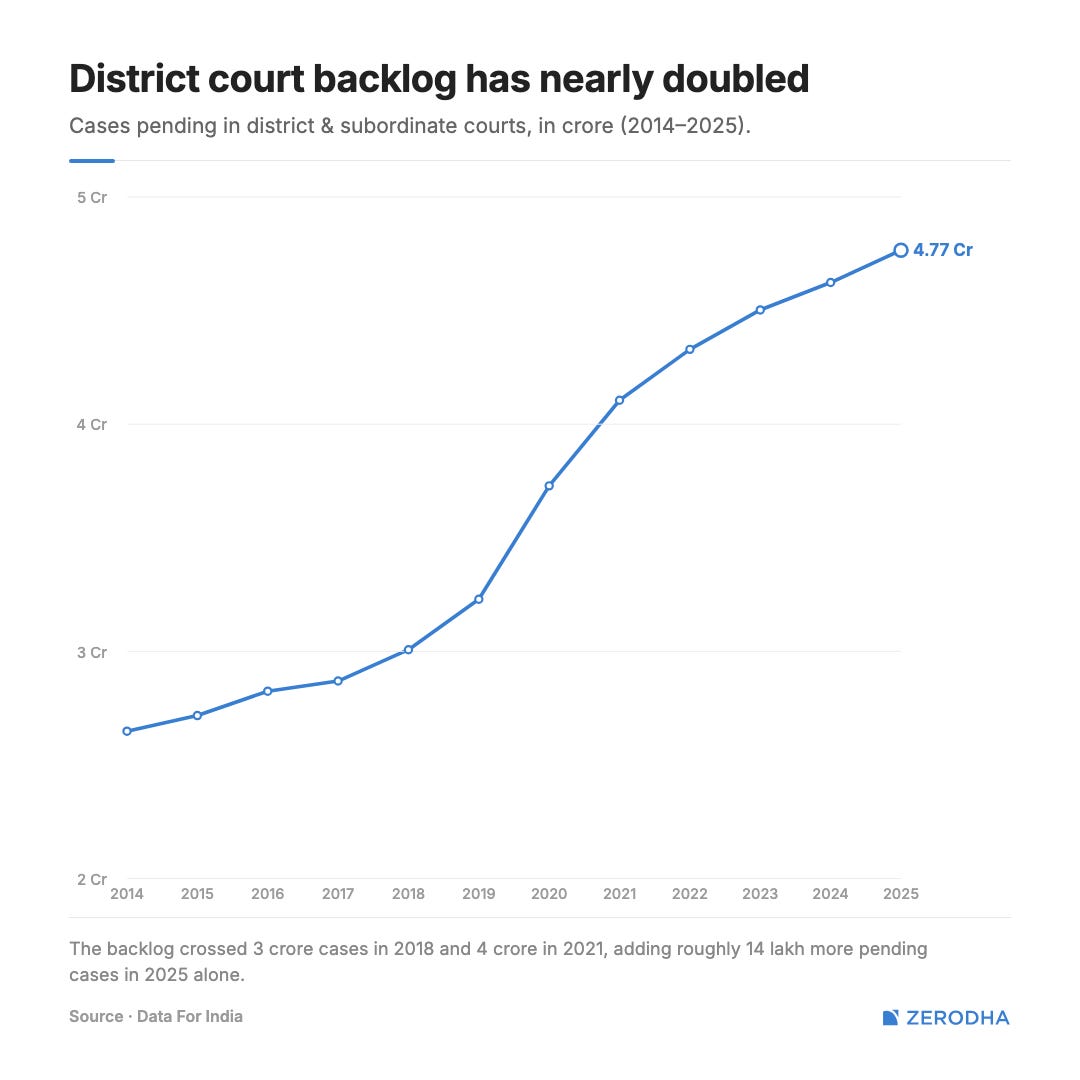
The lower-court backlog has risen from around 2.6 crore cases in 2014 to nearly 4.8 crore in 2025. Pendency in the High Courts and the Supreme Court also increased by close to 50% over the decade, although from much smaller bases.
So why does the queue keep growing? The arithmetic is simple. Every year in which courts receive more cases than they dispose of adds another layer to the backlog.
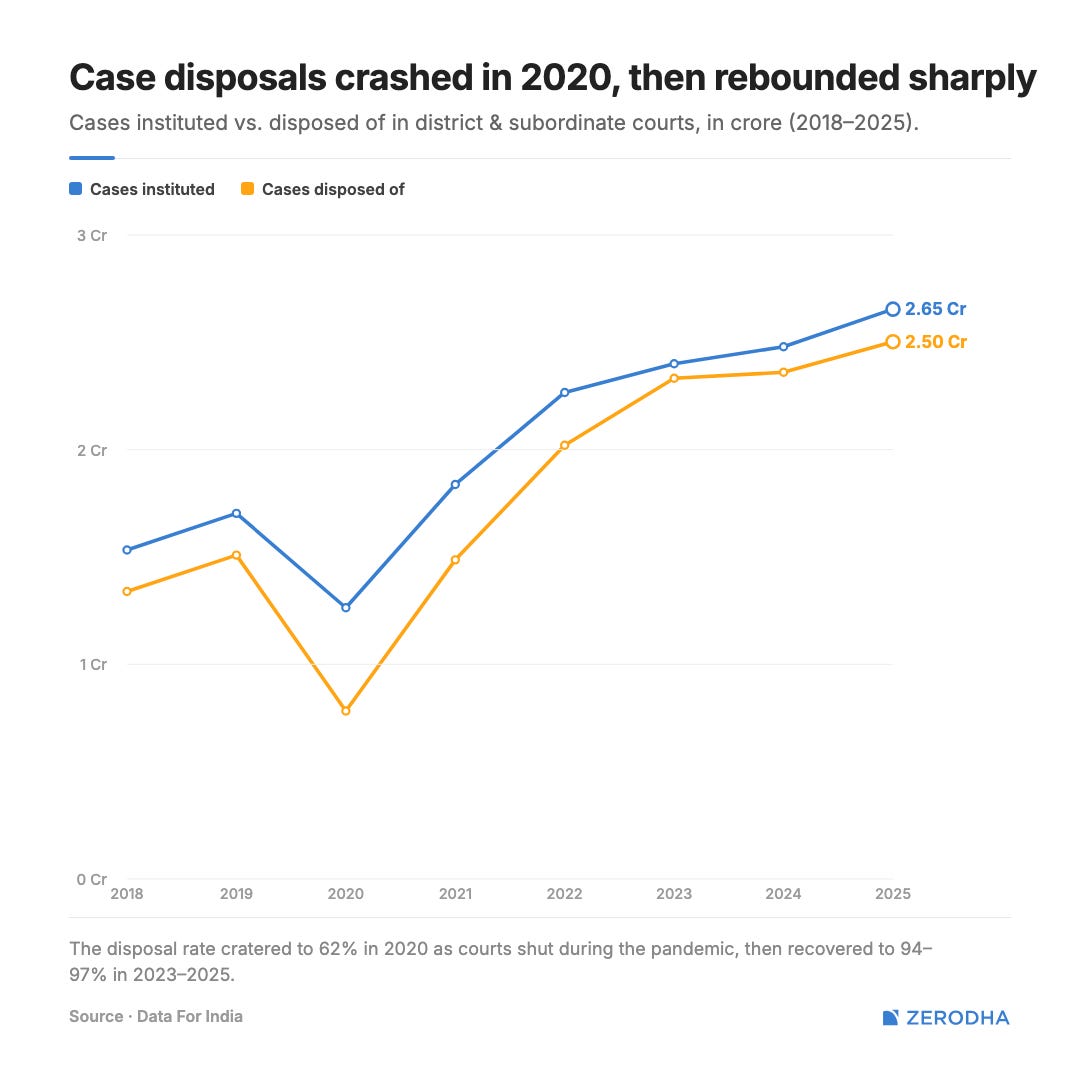
Between 2018 and 2025, district and subordinate courts received more cases than they disposed of in most years. The pandemic made this imbalance much worse. Courts could move some work online, but trials that depended on witnesses, physical evidence and in-person appearances were much harder to conduct. Disposals recovered later, but they did not consistently overtake new filings.
This chart covers only district and subordinate courts. The India Justice Report 2025 separately says that, at the national level, a few High Courts have recorded annual case-clearance rates above 100% since 2017. That means they disposed of more cases than were filed during those years.
The two findings are not contradictory. They concern different levels of the judiciary. The High Court figure also does not mean that every High Court crossed 100%, or that decades-old cases were the ones being cleared. A court can keep pace with today’s filings and still spend years working through yesterday’s backlog.
Where the backlog sits
The national number hides huge differences between states. Pendency in Delhi and Haryana’s subordinate courts roughly tripled over the decade. Uttar Pradesh’s backlog doubled from about 55 lakh to 1.13 crore, while Maharashtra’s doubled to around 60 lakh. Gujarat was the only state to reduce its pending caseload.
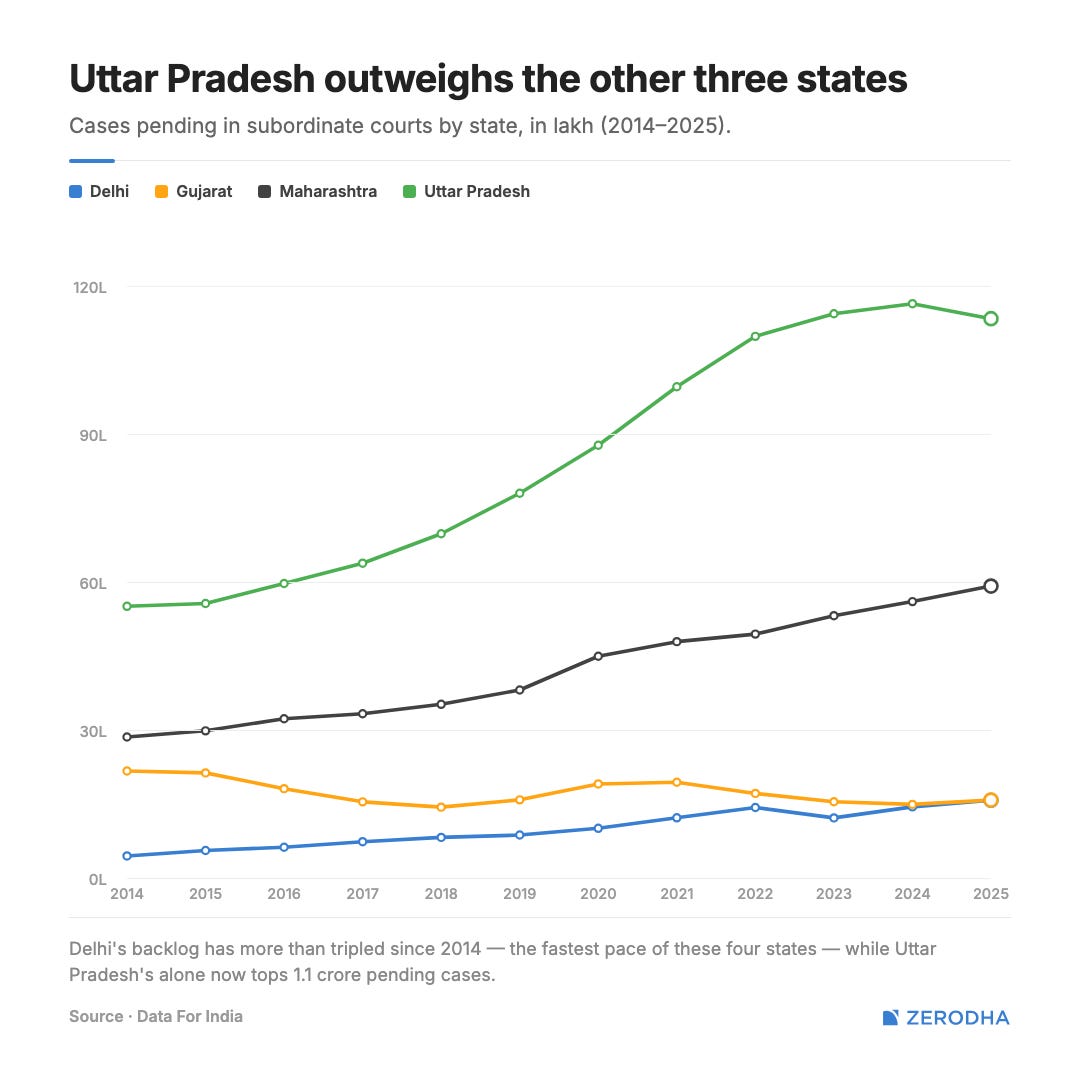
Let’s not make the mistake of confusing this as a league table of good and bad courts. Large and growing states naturally generate more property disputes, traffic violations, commercial cases and criminal proceedings. More litigation can also mean that people are more willing and able to use courts.
The reverse matters too. An older Vidhi Centre for Legal Policy study notes that long delays can eventually discourage people from filing cases. Low litigation, like low recorded crime, is not automatically good news.
High Courts are just as uneven. Rajasthan’s pendency rose by around 200% over the decade, while Himachal Pradesh and Uttarakhand recorded increases of more than 150%. Tripura, Calcutta, and Jammu & Kashmir and Ladakh reduced their backlogs. Yet Allahabad still carried far more pending cases than the other High Courts shown below.
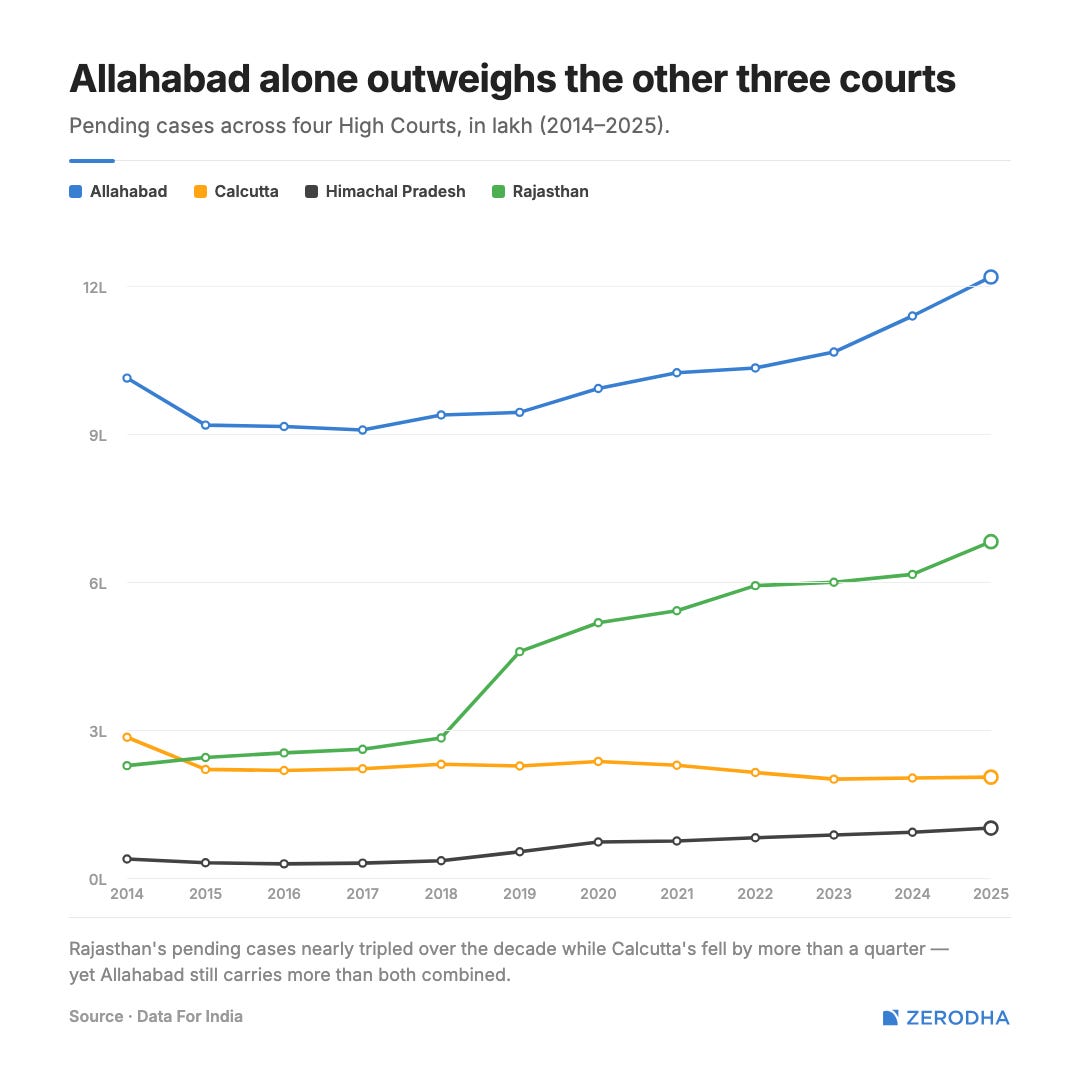
The percentages tell us where the backlog grew fastest. The absolute numbers tell us where the weight already was.
A backlog measured in decades
A growing queue is one problem. An ageing queue is worse.
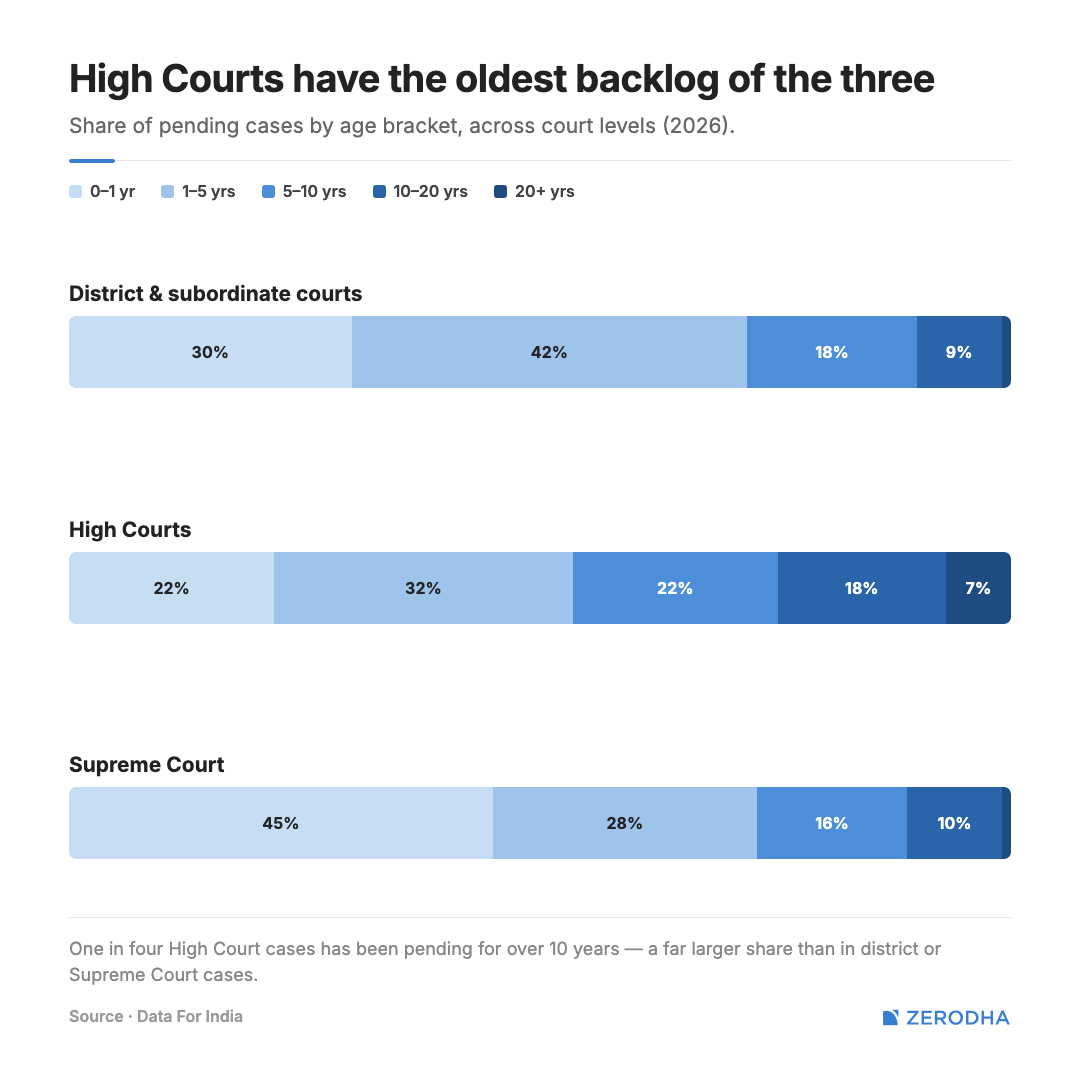
As of March 2026, nearly one in three district and subordinate court cases had been pending for more than five years, and around one in ten for more than ten. The High Courts were worse where almost every second case was older than five years, and roughly one in four had crossed a decade.
By 16 July 2026, 11.73 lakh cases across the Supreme Court, High Courts and lower courts had been pending for more than 20 years. District and subordinate courts alone had 81,275 cases older than 30 years.
A case rarely loses 20 years at once. It loses them through adjournments, unserved notices, missing witnesses, transferred officers, vacant posts and evidence that has not arrived.
The age profile also changes sharply by state. More than half of Bihar’s pending lower-court cases were older than five years. In Tripura, the share was around 6%.
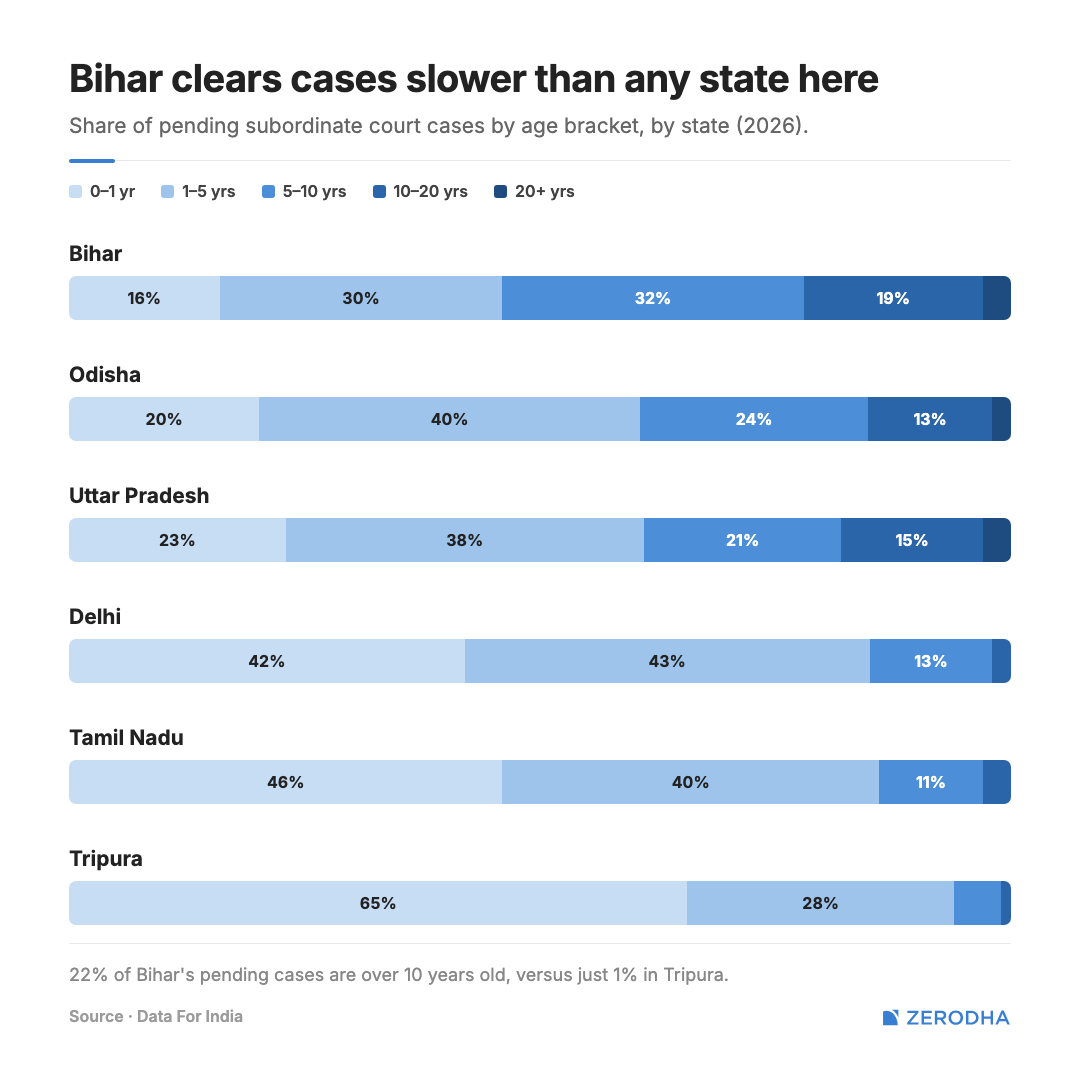
That comparison tells us where delay is concentrated but it does not tell us that judges in one state work harder than judges in another. States differ in caseload, staffing, infrastructure and the stage at which cases get stuck.
High Courts inherit part of their queue from lower courts and tribunals. A case can be tried, decided, appealed, sent back and heard again. They also hear writ petitions challenging government action on pensions, recruitment, land, taxes, detention and fundamental rights. One judgment may simply start the next proceeding.
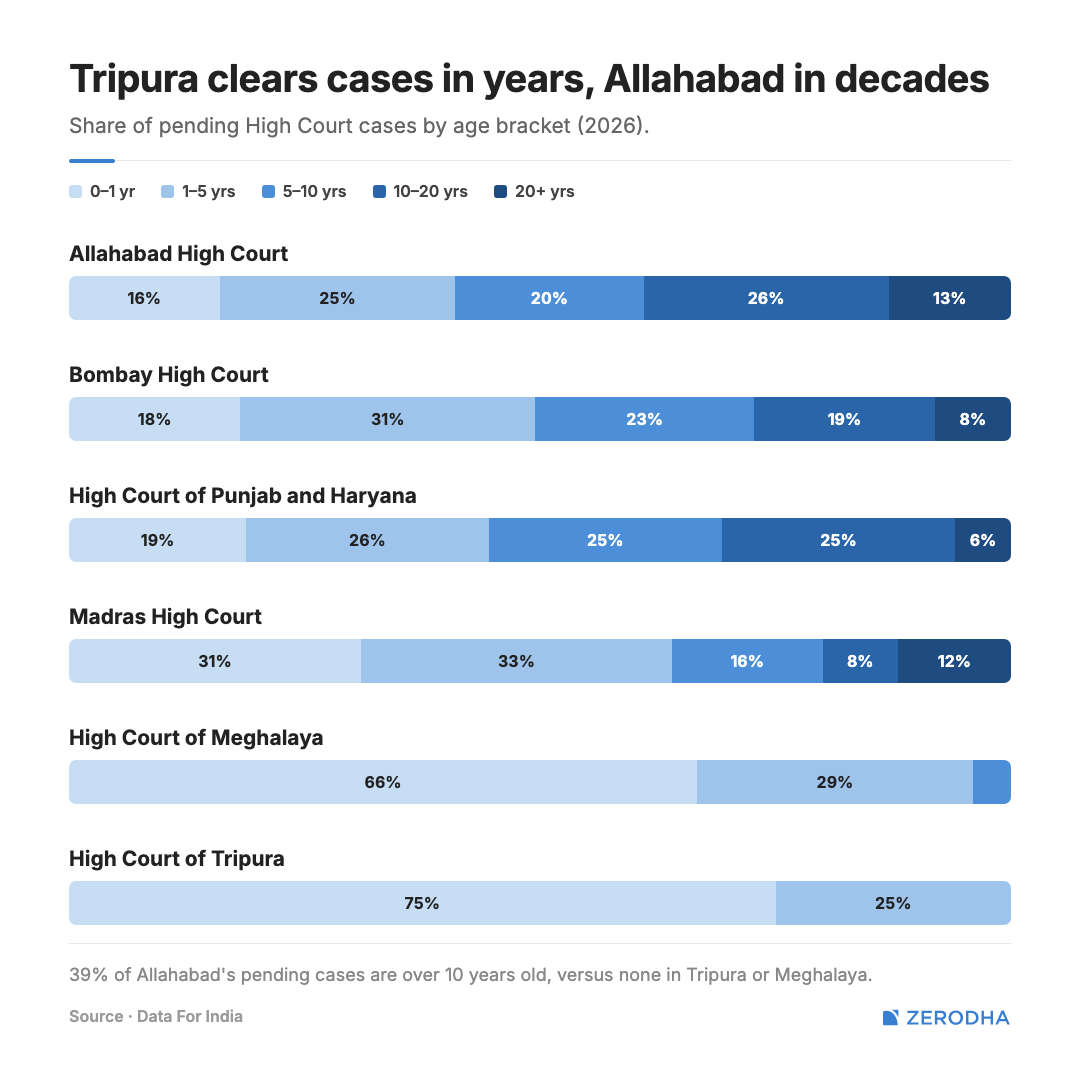
By July 2026, the Allahabad High Court alone had more than 1.61 lakh cases pending for over 20 years. Madras had more than 76,000 and Bombay more than 55,000.
When waiting becomes punishment
What fills the queue also changes as a case moves up the system. Lower-court pendency is overwhelmingly criminal. Higher courts lean civil.
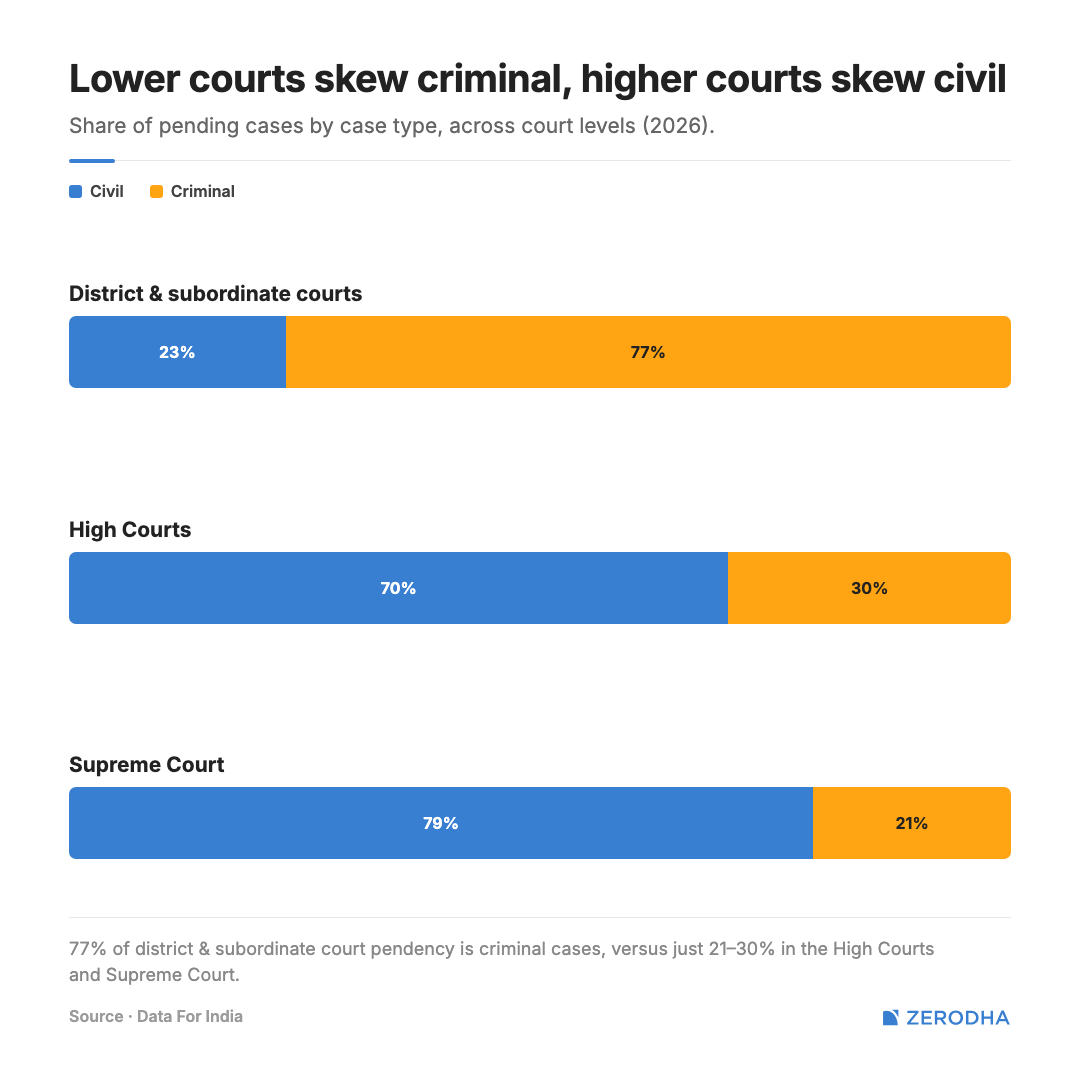
Around 77% of pending district and subordinate court cases were criminal as of March 2026. In the High Courts, 70% were civil; in the Supreme Court, the civil share was 79%. This follows the structure of the system. Criminal trials begin almost entirely in lower courts, while higher courts hear more appeals, civil disputes and constitutional cases.
The criminal backlog also has a consequence the chart cannot show, which is people waiting in jail.
At the end of 2023, India’s prisons had room for 4,39,119 people but held 5,30,333. Nearly 3.9 lakh were undertrials - people whose guilt had not yet been decided. They made up about 74% of the prison population, according to the Ministry of Home Affairs.
In one case decided in February 2025, an accused had spent five years in custody while prosecutors worked through a list of 100 witnesses. Only 42 had been examined, and the state could not say when the trial would finish. The Supreme Court granted bail, citing the accused’s fundamental right to a speedy trial.
That case is the danger hidden inside the 77%. For a civil litigant, delay can mean frozen property or unpaid money. For an accused who cannot secure bail, it can mean years in prison before the state proves its case.
The punishment may begin before the judgment.
How the queue can shrink
The backlog is produced at both ends. Some matters enter court even though they could have been resolved another way. The cases that do need a judge then move too slowly.
It is tempting to conclude that India simply has too many cases. But the number of filings is not a clean measure of excess litigation. More cases can mean that more people are able to report crimes and enforce their rights. Fewer cases can mean that disputes were settled early; they can also mean that people gave up. The aim cannot be a smaller queue at any cost.
There is still avoidable traffic. For example, the government issues tax demands, acquires land, recruits employees and runs benefit schemes, then frequently appeals when it loses. One study of admitted Supreme Court cases found that governments were the appellants in 73% of the sample. Their success rate was below 50% in some categories, including tax matters. Better decisions inside government, and stricter checks before an appeal is filed, could prevent some disputes from climbing the judicial ladder.
Minor offences need not always become full criminal cases either. In April 2026, Parliament passed the Jan Vishwas (Amendment of Provisions) Bill, 2026, which decriminalised 717 provisions across 79 central laws. The idea is to replace criminal consequences for many minor breaches with civil or administrative penalties. Virtual courts offer another route: 21 of them had handled more than 2.78 crore cases by March 2023. These measures can reduce future inflow, but they do little for the murder trials, bail applications, property suits and constitutional challenges already waiting.
Suitable civil and commercial disputes can also be resolved through mediation or Lok Adalats, sometimes before a suit is filed. But moving a dispute outside court is useful only when the process is fair. Serious crimes cannot be bargained away, and a worker, tenant or victim may not negotiate with a powerful counterparty on equal terms. Access to justice must not be reduced in the name of reducing pendency.
Then comes the second problem: giving necessary cases enough capacity to move. In early 2025, around 33% of High Court judge posts and 21% of subordinate-court judge posts were vacant. Vacancies were also substantial among stenographers, law clerks and other non-judicial staff. Nearly half of roughly 10,000 sanctioned posts in state forensic facilities were vacant in the data used by the India Justice Report. A case may sit on a court’s list even when the evidence is stuck in a laboratory.
This is why the backlog cannot be explained as simple laziness. Adjournments, judges’ absences and slow judgments do contribute. So do unserved notices, witnesses who do not appear, missing police records, delayed forensic reports and vacancies among clerks and prosecutors. Filling judge posts matters, but research cited by Data For India found only a weak relationship between judge strength and case-clearance rates. A judge can decide only the case that is ready to be heard.
There is no single reform that clears every blockage. India can keep minor regulatory offences out of criminal courts, settle suitable disputes earlier, stop departments from appealing weak cases, fill support and forensic vacancies, and finish the courtrooms and housing already being built. Each measure shortens a different part of the queue.
The visible queue
India does not have one queue of 5.4 crore cases. It has millions of queues running through police stations, government offices, forensic laboratories, courtrooms and prisons. A delay anywhere along that chain eventually appears under the same harmless-sounding label: “pending”.
Even the 5.4 crore figure counts only the cases that made it far enough to enter the system. The complaint never registered, the crime never reported and the person who gave up before approaching court remain outside the charts. A fall in pendency would mean little if it came from making that invisible group larger.
Real progress would look different: more people able to seek justice, fewer avoidable disputes entering a courtroom, and necessary cases reaching a decision sooner. India already has many of the tools. The work is to use them together without closing the courthouse door.
See you next edition :)
good 👍 information, india will badly needed to fix this to improve the country. need to have digital compulsory, have more technology in place, need TAT for the case's...