


Hello, and welcome to this week’s edition of Points & Figures, put together by Kulsum & Mridula.
The idea is simple: to tell stories about the Indian economy, financial markets and investing through data. Instead of throwing random charts at you, we dig into overlooked datasets to explain shifts and trends you may otherwise miss.
This edition draws on research by CareEdge on India’s microfinance industry. Their work looks at how the sector has emerged from a difficult period, what drove the recovery, and which parts of the industry came out stronger.
P.S: Big thanks to our colleague Kashish for helping us put together this edition :)
Microfinance loans are, by definition, small, collateral-free loans given to low-income households. Under the RBI’s current rules, any collateral-free loan to a household earning up to ₹3 lakh a year counts as microfinance. The loans may be micro. The problem the industry created was anything but.
After Covid, demand for credit came roaring back. Households needed money, and lenders were eager to supply it. Then, in 2022, the RBI rewrote the rules of the industry. Earlier, NBFC-MFIs operated under fairly prescriptive limits on who they could lend to, how large those loans could be and even how they could price them. The new framework widened eligibility to all households earning up to ₹3 lakh a year, removed the old loan-size and pricing caps, and instead asked lenders to set their own interest rates under board-approved policies. The idea was to let lenders serve more low-income borrowers while keeping total household repayments within 50% of monthly income.
That was broadly a good thing. Microfinance has never lacked demand; the harder problem has been getting enough formal credit to the people who need it. The new rules made that supply easier to expand. And expand it did.
Perhaps a little too well. In the rush to grow, underwriting started slipping. Borrowers became increasingly stretched, repayments weakened, credit costs shot up and lenders began writing off loans at an uncomfortable pace. By FY25, the industry was firmly in trouble.
Two years later, microfinance finally appears to be recovering. But this is not a simple bounce back to normal. The industry had to shrink, clean up old loans and rethink how it lends. And the recovery has not reached every lender equally.
The charts that follow tell that story: what went wrong, what changed, and who actually made it out of the woods.
(Sidenote: We also spoke to a Tamal Bandyopadhyay veteran banking journalist about the microfinance recovery. If this story interests you and you want to go deeper, you can watch that interview here.

Closing one of microfinance’s biggest loopholes
To understand the recovery, it helps to start with one of the problems that made the downturn worse in the first place: borrowers taking loans from too many lenders.
One of the oldest problems in microfinance is evergreening. A borrower takes a loan from one lender to repay another, then keeps the cycle going. On paper, individual loans may still look current. Underneath, the borrower may already be under stress.
That is why headline NPA numbers do not always tell you enough. A useful early warning sign is how many lenders a borrower is dealing with, and how much total debt she is carrying.
Until recently, there were few hard guardrails around this. There was no industry-wide cap on total microfinance indebtedness and no limit on how many microfinance lenders could lend to the same borrower.
The industry is now trying to close that gap. Microfinance indebtedness is capped at ₹2 lakh, unsecured retail loans are included while assessing leverage, and a borrower can no longer take loans from more than three microfinance lenders.
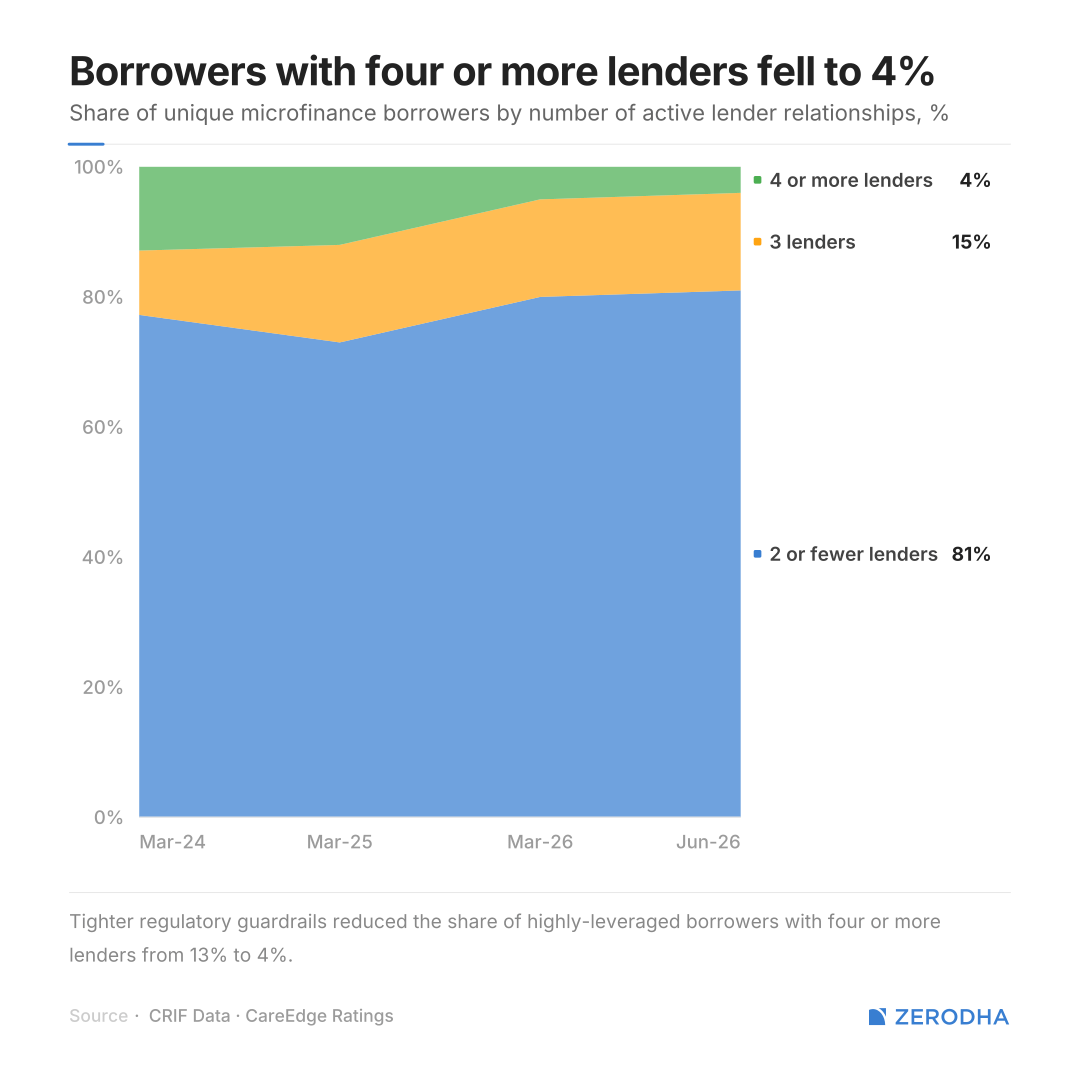
The effect is visible. In March 2024, 13% of borrowers had loans from four or more lenders. By June 2026, that number had fallen to 4%. Meanwhile, the share dealing with two or fewer lenders rose to 81%.
The data in microfinance is still far from perfect. But this is a useful way to see whether borrowers are genuinely becoming less stretched, rather than simply looking healthy in reported NPA numbers.
Fewer borrowers, but larger loans
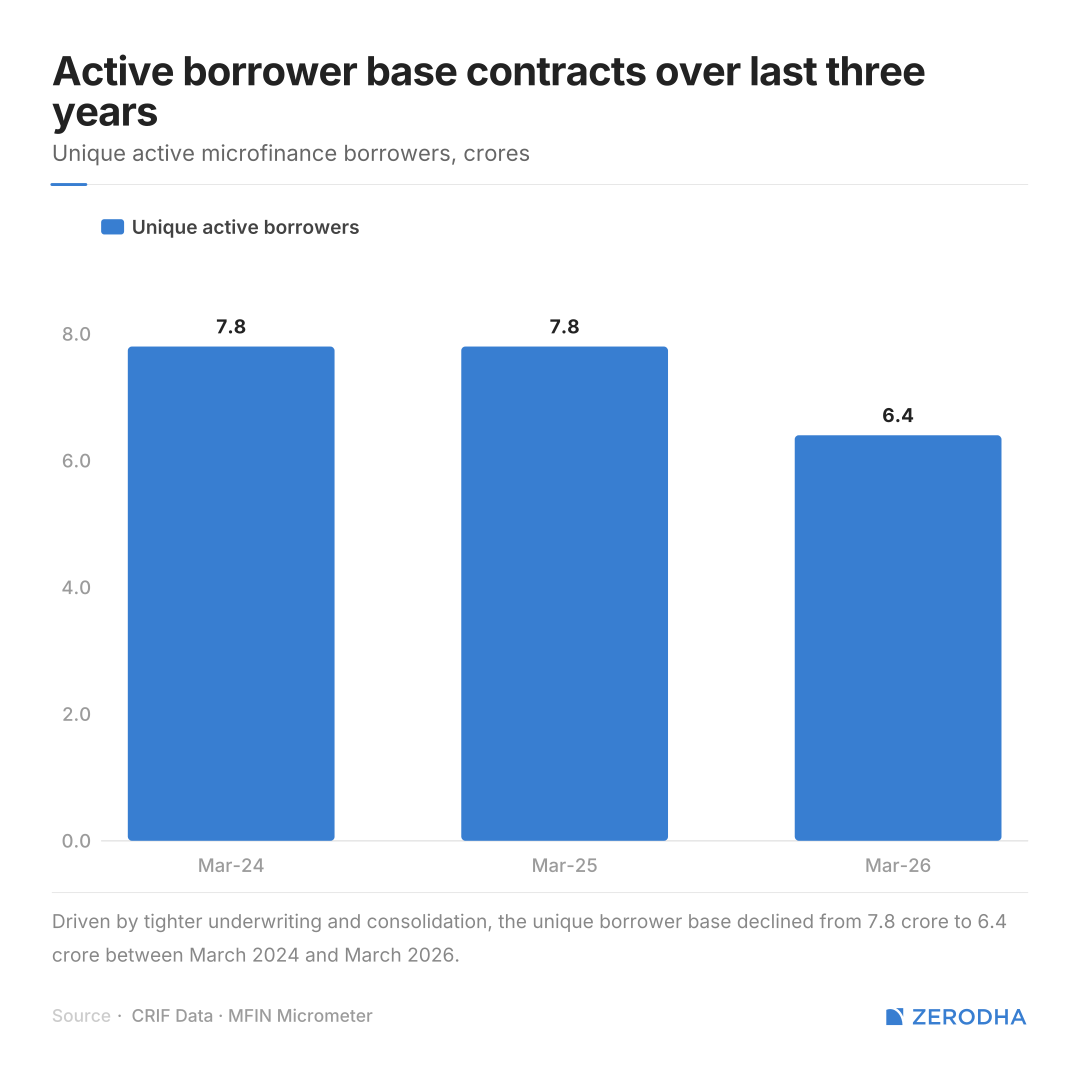
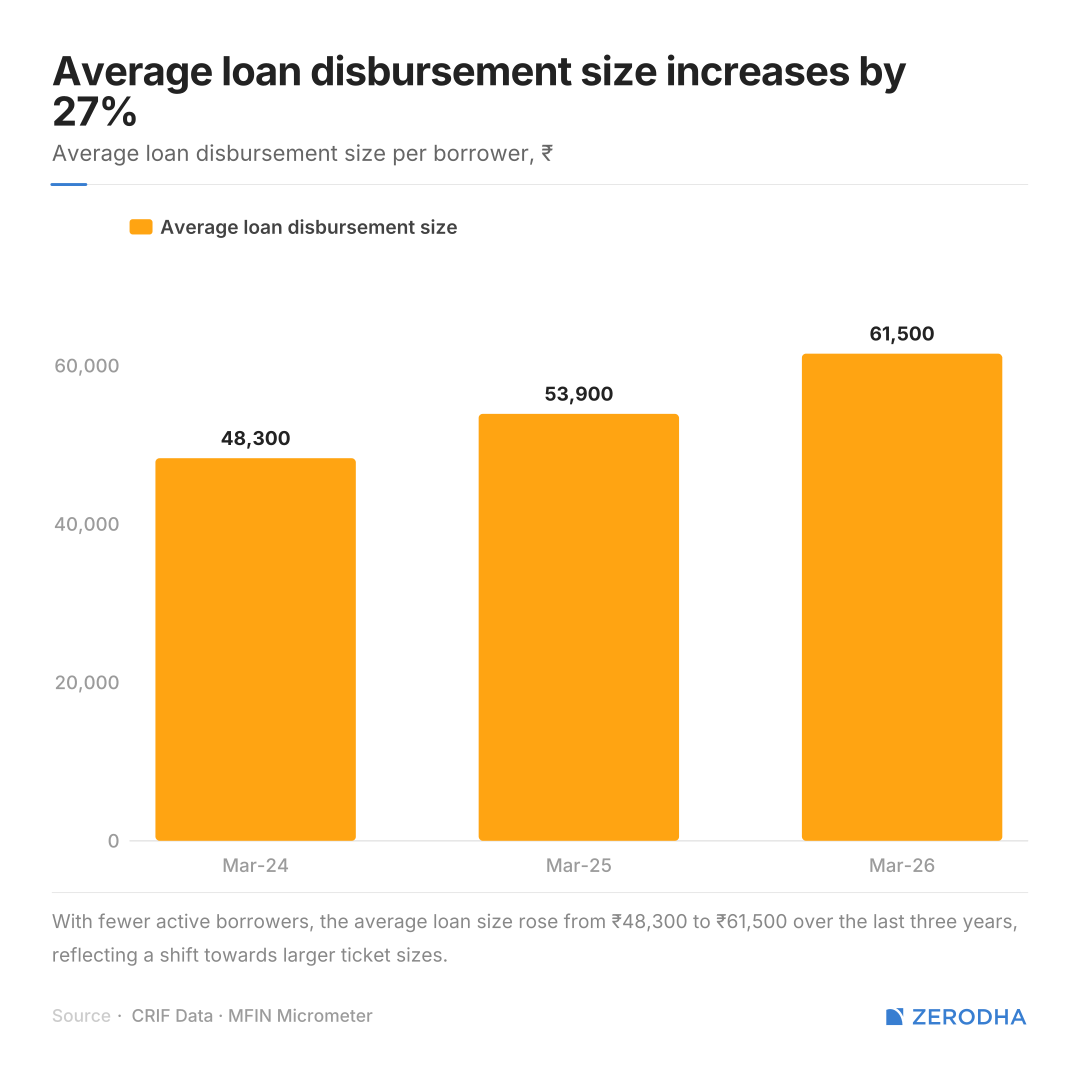
Those guardrails did more than reduce multiple borrowing. They also made lenders much more selective about who got a loan in the first place.
The tightening was sharp enough that the number of borrowers in the industry actually fell. Unique microfinance borrowers declined from 7.8 crore in March 2024 to 6.4 crore in March 2026. At the same time, the average disbursement increased from ₹48,300 to ₹61,500.
Some of this is healthy. Borrowers with several existing loans, overdue payments or weak repayment capacity are being filtered out. But it also means AUM alone can give an incomplete picture. A lender can rebuild its loan book by giving larger loans to a smaller group of safer customers.
So yes, the microfinance balance sheet may be getting healthier. But that does not automatically mean credit is reaching more people. For now, the opposite is true.
A lot of the old problem had to be thrown away
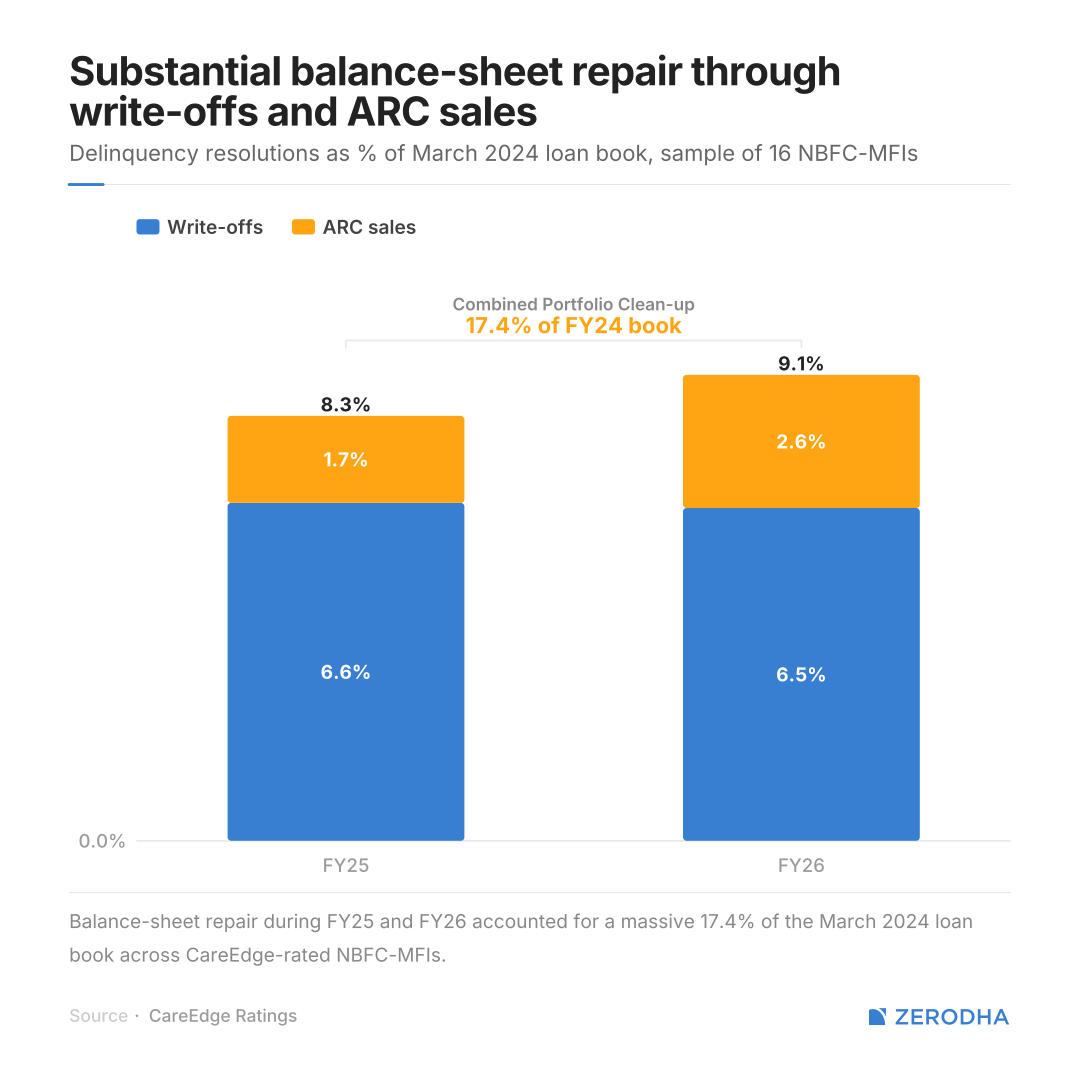
But tightening new lending only solves half the problem. Lenders still had quarters of stressed loans sitting on their books.
And a large part of that stress did not disappear because borrowers suddenly began repaying.
Across 16 CareEdge-rated MFIs, write-offs and sales to asset reconstruction companies during FY25 and FY26 were equivalent to more than 17% of their March 2024 loan book. Write-offs alone accounted for 13.1%.
This was necessary balance-sheet surgery. Recognise the loss, remove the worst assets and give the surviving portfolio room to recover.
But it also puts the recovery in perspective. Improving delinquency numbers cannot be read as a complete return to normal if a large chunk of the old problem has simply been taken off the books. The stronger evidence, then, has to come from what happens to loans made after the cleanup.
The loan book has finally stopped shrinking
Put tighter new lending and the cleanup of old loans together, and the result was inevitable: the industry became much smaller.
Lenders were making far fewer new loans, closing out older ones and removing stressed accounts. Microfinance AUM fell from ₹4.34 lakh crore in March 2024 to ₹3.15 lakh crore by December 2025.
That decline was one of the clearest signs that something had gone wrong. But a falling loan book by itself does not tell you the industry is getting healthier. It may simply mean lenders have stopped growing because they are still dealing with the damage.
The more important signal came when that trend finally reversed.
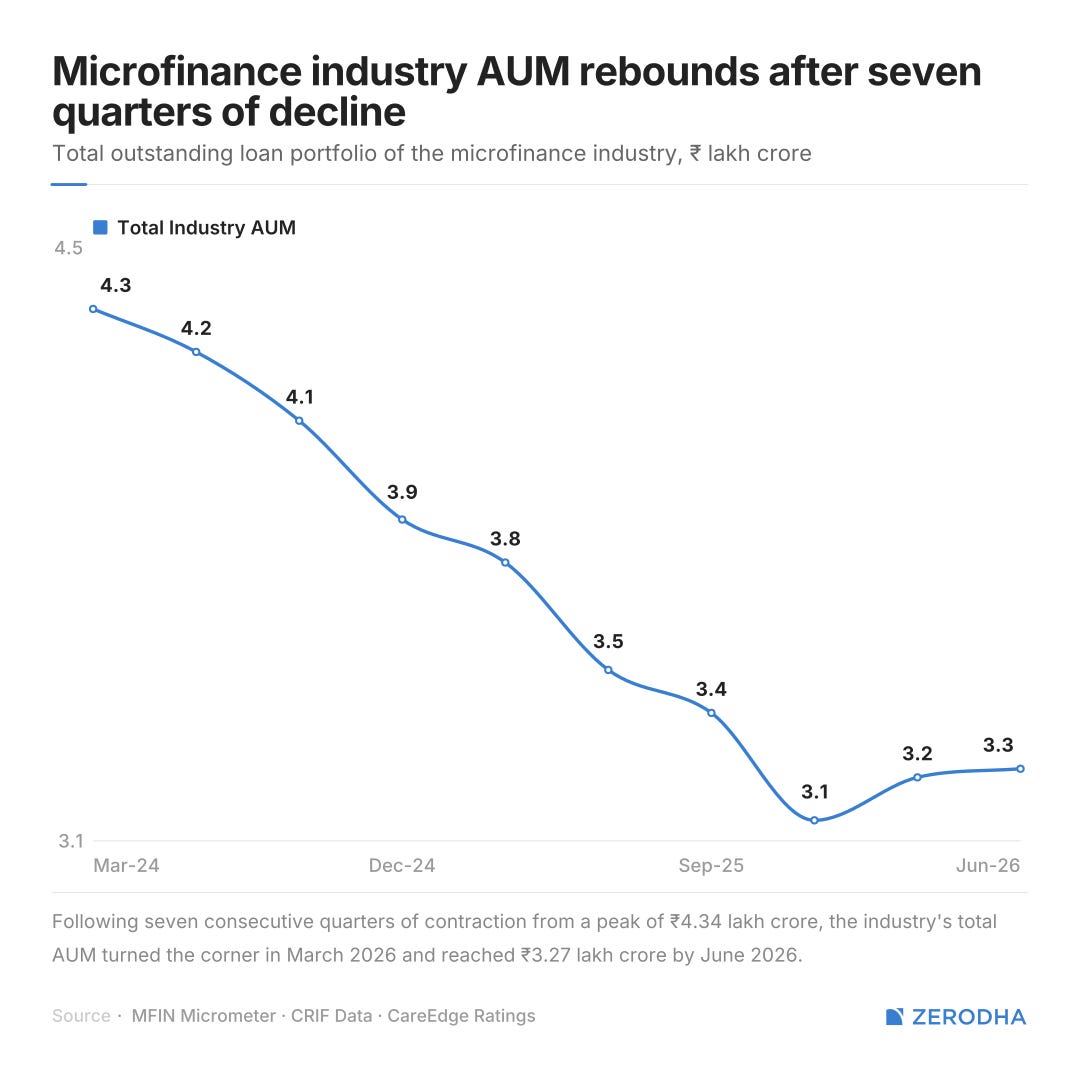
In March 2026, AUM grew 3.3% over the previous quarter—the first sequential increase after seven quarters of decline. It edged up again in June.
That is why several MFI management teams started saying the worst was behind them. By then, much of the older stress had been recognised or cleaned up. So incremental lending should, at least in theory, be more deliberate than what came before.
The recovery still looks modest compared with the growth before the crisis. But after nearly two years of shrinking, even some growth is a relief. More importantly, the industry does not need another sprint. It needs to prove that it can grow without recreating the same problem.
The lending tap is open again, just not fully
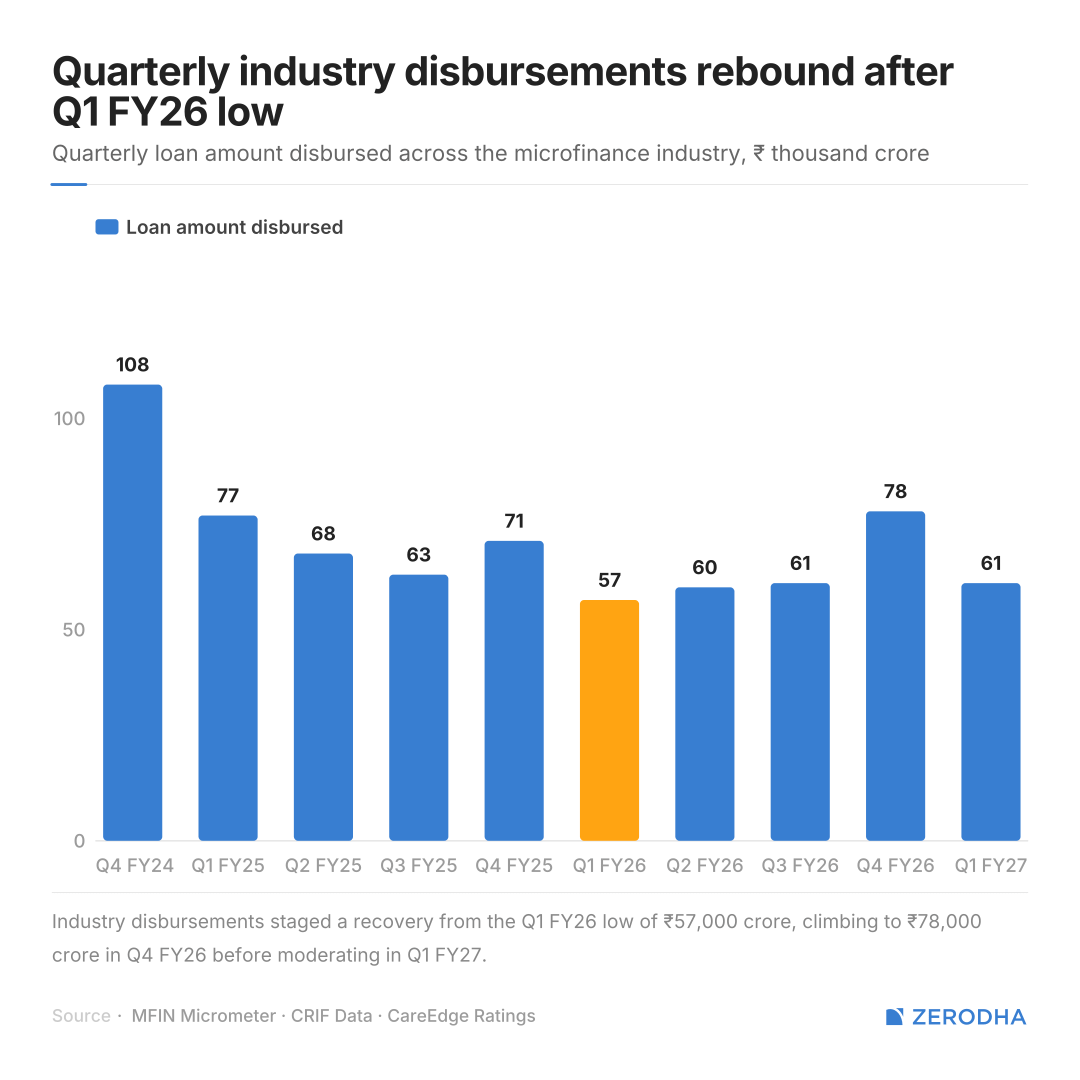
And once the loan book stopped shrinking, the next question was obvious: are lenders actually willing to lend again? When a lending cycle turns bad, the easiest way to avoid new defaults is to stop making new loans. That is exactly what happened.
Quarterly microfinance disbursements fell from approximately ₹1.08 lakh crore in Q4 FY24 to ₹57,000 crore in Q1 FY26. By Q4 FY26, they had recovered to nearly ₹78,000 crore—the highest level in eight quarters—before falling back to around ₹61,000 crore in Q1 FY27.
So the lending tap is open again. Just not all the way.
This is not a clean V-shaped recovery. Lenders are willing to grow again, but concerns around weather, rural incomes and fresh borrower quality are keeping them cautious.
That is probably sensible. The previous crisis was created partly because the industry confused rapid disbursement growth with progress. This time, every new rupee lent has to be weighed against the risk of returning to the same old habits.
The new loans are behaving better
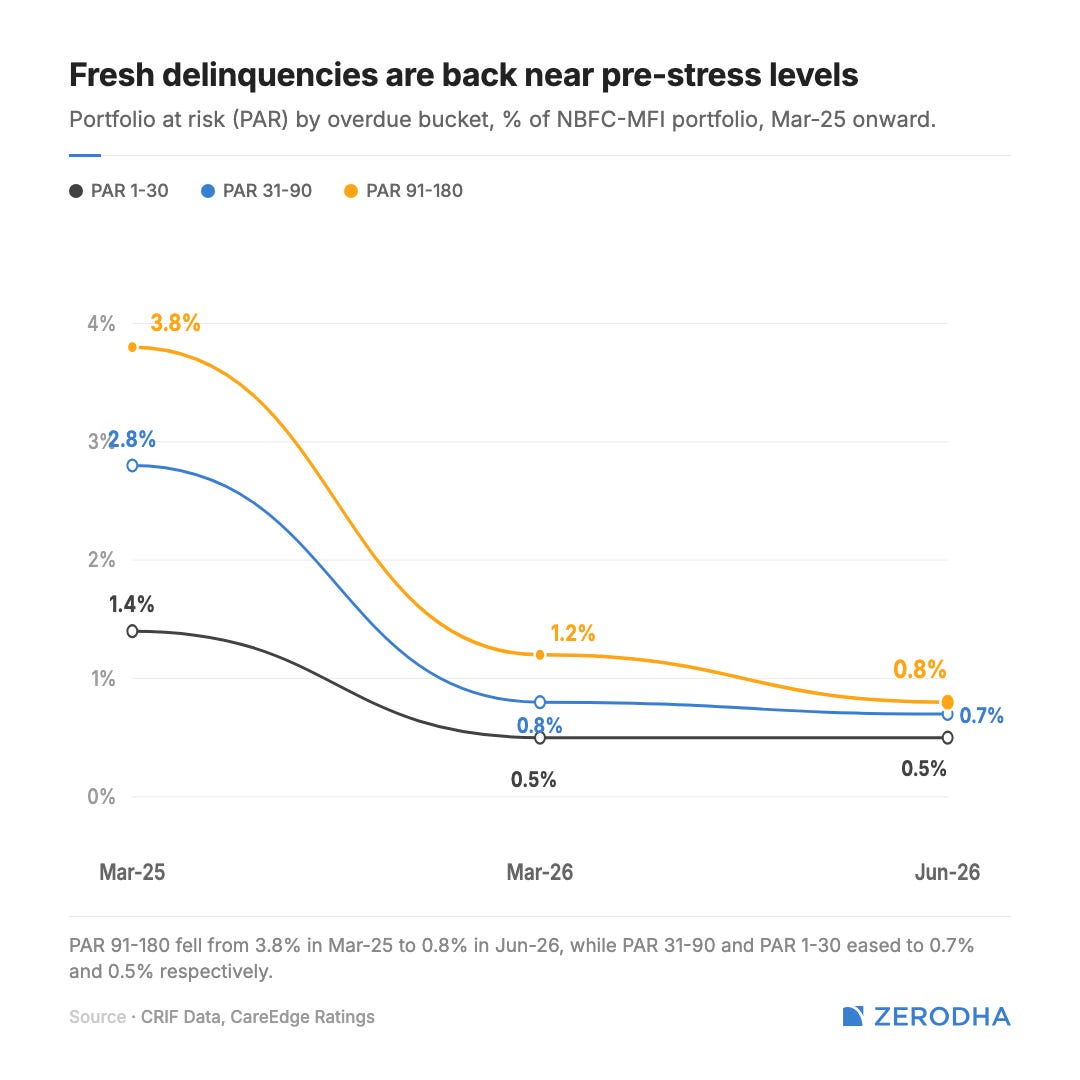
More lending, though, only counts as a recovery if the new loans do not start going bad again. Write-offs can clean up old defaults. They cannot hide borrowers who have only just started missing payments. That makes the early overdue buckets particularly useful.
PAR 1–30 fell from 1.4% in March 2025 to 0.5% in June 2026. PAR 31–90 declined from 2.8% to 0.7%, while loans overdue by 91–180 days fell from 3.8% to 0.8%.
The improvement across all three buckets suggests that fresh loans are genuinely performing better. Fewer borrowers are slipping into default, and fewer overdue accounts are progressing into more serious stress.
This is probably the strongest evidence that the recovery is not only cosmetic. The industry has cleared a lot of the old damage and, at least for now, appears to be creating less new damage.
But there is one caveat. The industry is still lending far less aggressively than it did before the crisis. Credit discipline is easier to maintain while growth is subdued. The real test comes when lenders start chasing growth again.
Profitability is returning because bad loans cost less
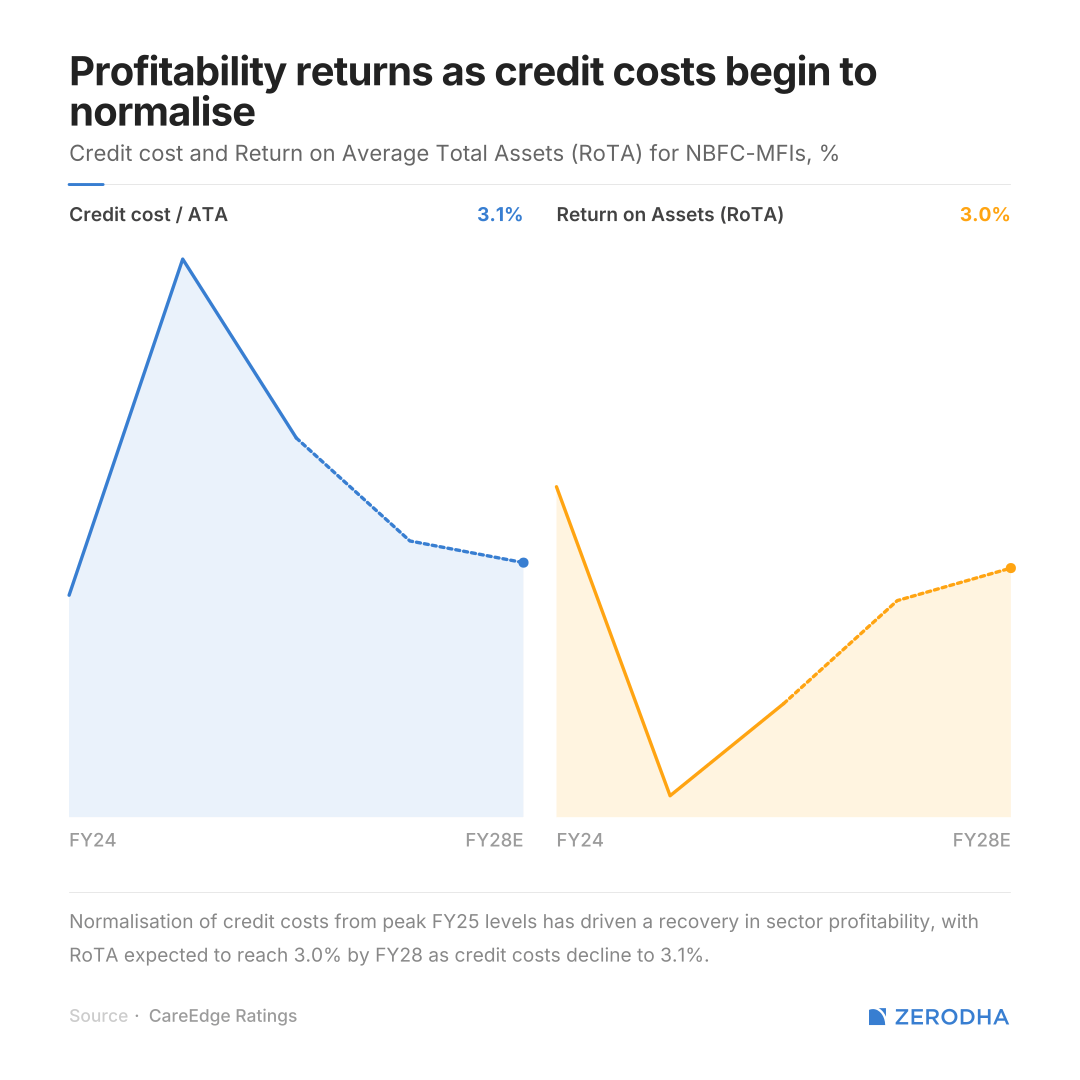
That improvement in loan quality is now showing up exactly where you would expect it to: profits. The improvement in MFI profitability is not being driven by wider margins or dramatically lower operating expenses. It comes largely from one place: bad loans are becoming less expensive.
Credit costs rose from 2.5% of average total assets in FY24 to 8.7% in FY25. That was enough to push return on assets to –1.2%. By FY26, credit costs had fallen to 5.4% and return on assets recovered to 0.5%.
CareEdge expects Return on Average Total Assets (RoTA) to reach 2.4% in FY27 as credit costs fall further.
But this also shows how fragile the earnings recovery is. If lenders loosen standards, delinquencies rise and credit costs shoot up again, profits can disappear remarkably quickly.
For microfinance lenders, asset quality is not one part of the earnings story. Right now, it is the earnings story.
So, at an industry level, the recovery is becoming fairly convincing. But industry averages hide another part of the story: not every lender went through the downturn in the same way.
Banks stepped back faster. MFIs stayed in the game
When things got messy, everyone pulled back. Banks reduced microfinance lending, and NBFC-MFIs did too. The difference was that banks could afford to do it much more aggressively.
Microfinance is only one part of a bank’s loan book. If risk rises, it can simply send that money somewhere else. An NBFC-MFI has far less room to manoeuvre. Its branches, field officers and collection networks are built around this business.
So MFIs stepped back, just not as sharply. The result is that their market share actually increased.
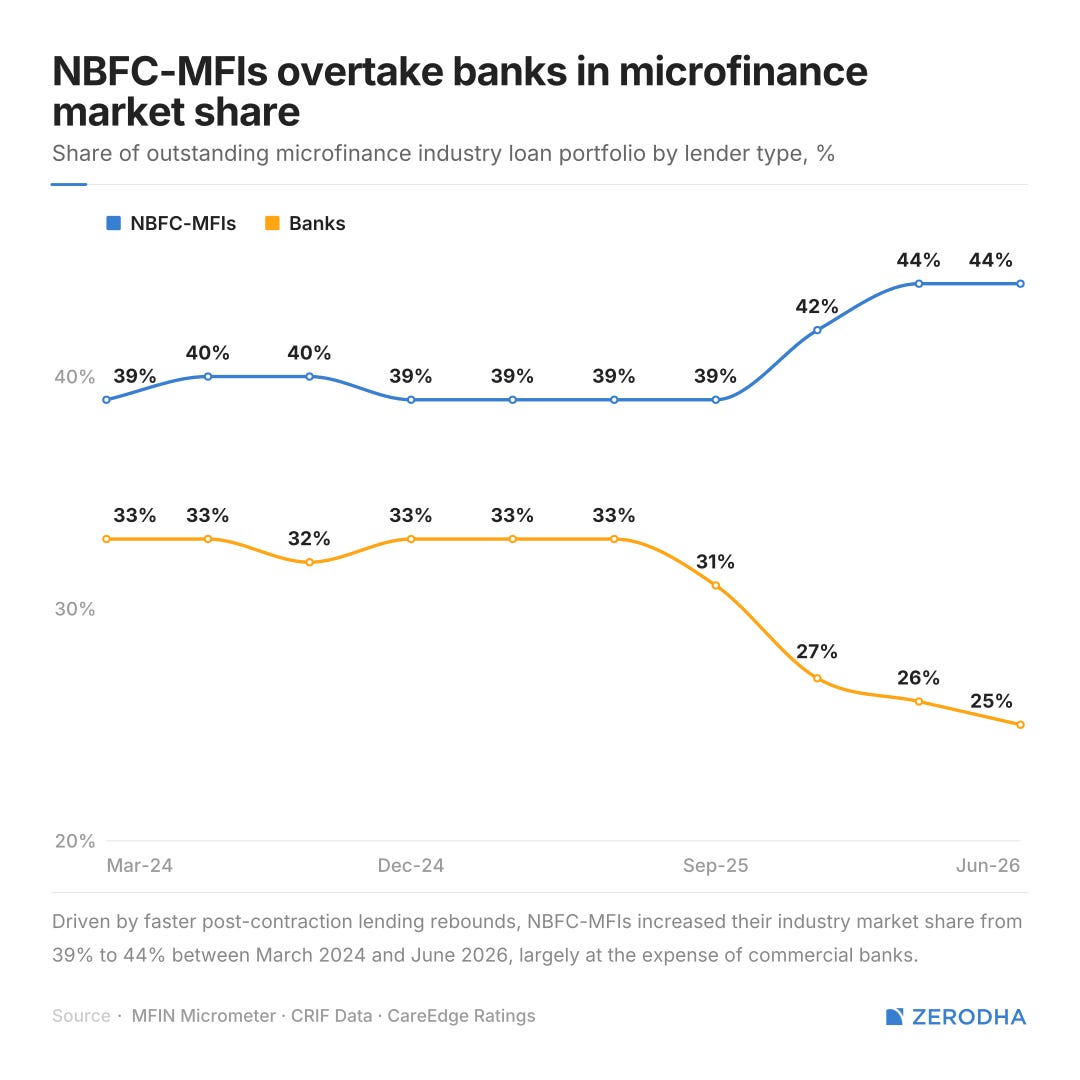
Banks accounted for 33% of microfinance AUM in March 2024. By June 2026, that had fallen to 25%. NBFC-MFIs moved in the opposite direction, from 39% to 44%.
That does not necessarily mean MFIs have permanently won this market. Banks can ramp up again just as quickly if they decide the risk-reward has improved.
The more interesting question is whether they will.
If they do not, this shift in market share may end up looking less like a temporary crisis response and more like the industry’s new normal.
Large MFIs have more escape routes
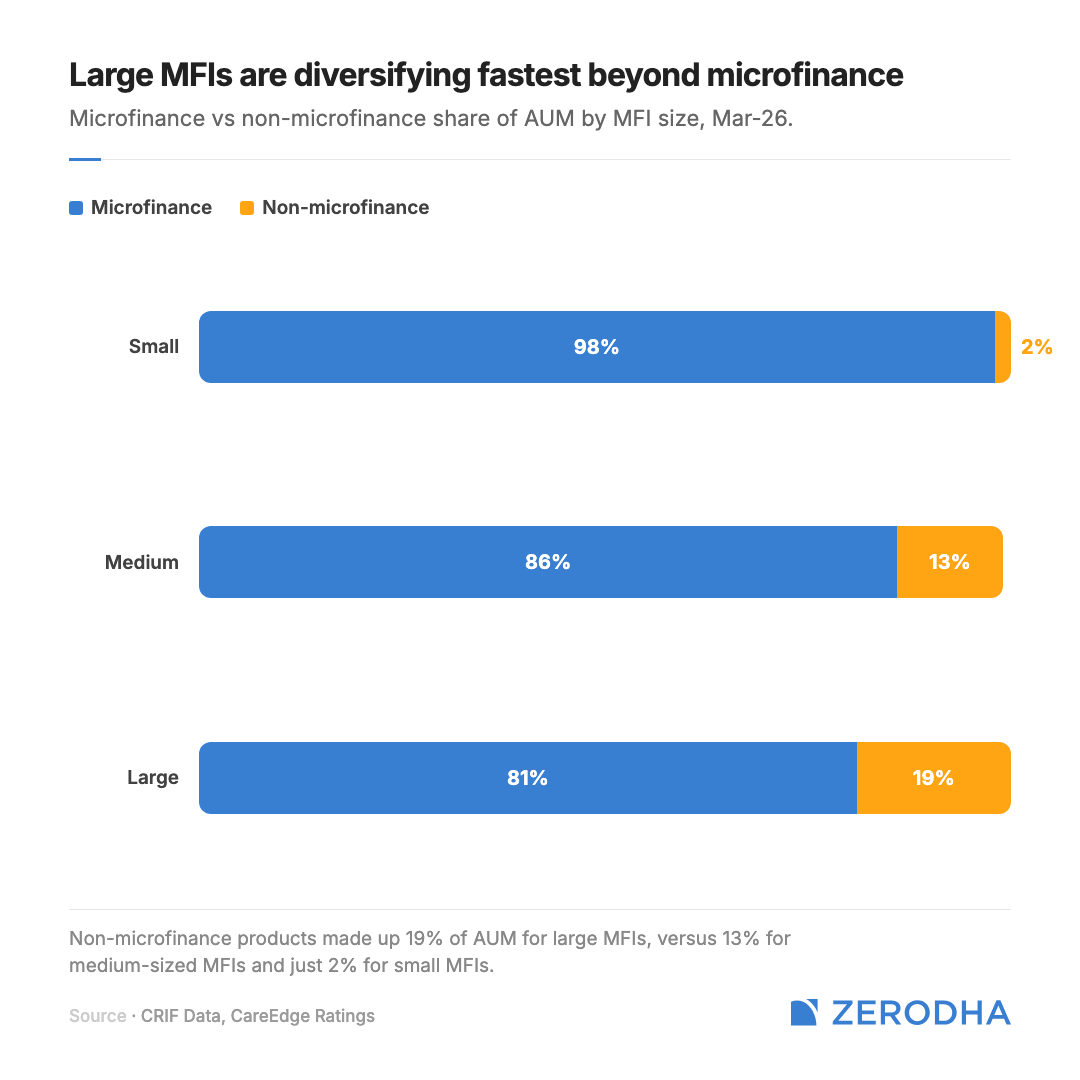
And the divide is not just between banks and MFIs. Even within microfinance, the largest lenders have much more room to escape when the cycle turns bad.
The RBI has lowered the share of assets that NBFC-MFIs must hold in qualifying microfinance loans from 75% to 60%. In theory, that gives every MFI more room to diversify. In practice, the advantage belongs overwhelmingly to the largest institutions.
Non-microfinance products already account for 19% of large MFIs’ AUM, compared with 13% for medium MFIs and just 2% for small ones.
Diversification requires more than regulatory permission. A lender needs capital, technology, distribution and the ability to assess unfamiliar borrowers. Large MFIs can use their existing networks to move into adjacent retail loans. Smaller institutions remain almost completely dependent on traditional microfinance.
So when the microfinance cycle turns bad, large lenders have somewhere else to go. Small lenders are stuck inside the cycle.
And even if a smaller MFI wants to grow again now, there is another problem: it first needs someone willing to fund it.
And then there is the 98% problem
That is where the recovery starts looking decidedly two-speed.
On paper, funding conditions are improving. NBFC-MFIs raised nearly ₹77,600 crore in FY26, up from about ₹58,200 crore in FY25.
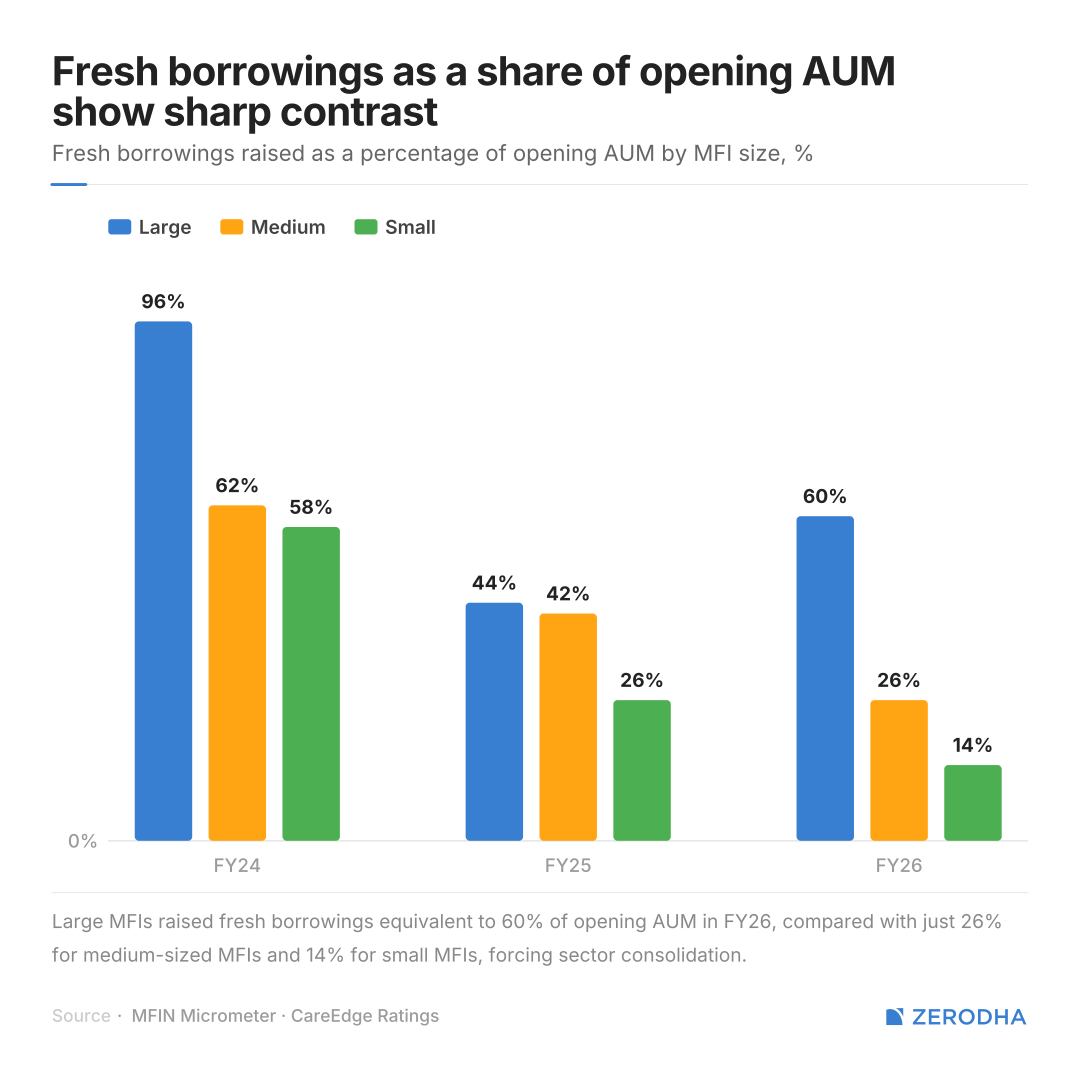
But almost all of that money went to one corner of the industry. Large MFIs accounted for 98% of incremental borrowing.
Large institutions raised fresh debt equal to 60% of their opening AUM. Medium MFIs managed 26%. Small MFIs raised only 14%.
This matters because MFIs depend on borrowed money to issue fresh loans. A small lender may have willing borrowers, good collections and deep local knowledge, but none of that produces growth if banks are unwilling to fund it.
The winners of the next microfinance cycle may therefore be decided before the loans are even made—by who can raise the money in the first place.
So, is microfinance really out of the woods?
Mostly, yes. Borrowers are dealing with fewer lenders, fresh delinquencies are falling, disbursements have restarted and profits are returning. The industry looks healthier than it did a year ago.
But it has become healthier partly by lending to fewer people, writing off a large part of the old loan book and concentrating fresh funding among the biggest institutions.
That creates a slightly uncomfortable conclusion. The microfinance sector may be recovering, while some smaller lenders—and some borrowers who depended on them are still being left behind.