

Hello, my name is Krishna and this is our third edition of Points & Figures.
This is a rebranding of a newsletter we used to publish under The Chatter. In its new avatar, the idea is simple: to tell stories about the Indian economy, financial markets, and investing through data visualizations (and anything else that caught our attention).
This has been a long-pending idea. We simply couldn’t do it earlier because the team that runs all the initiatives under Markets is barely six or seven people. Considering that we already do more than many much larger publishing teams, the idea of telling stories through data visualizations remained just that—an idea.
But thanks to the affordances offered by tools like Claude and ChatGPT, our small, close-knit team is able to do more than ever before.
The goal of this publication isn’t to send you a bunch of random, out-of-context charts—although we might occasionally do that. Pretty much everybody does that already, and there’s little value in us doing the same thing.
Instead, our aim is to take large datasets that are often overlooked or underappreciated and use them to tell stories about important aspects of the Indian economy and financial markets. In the editions to come, you’ll see data-driven stories about trends, shifts, and developments that you might not otherwise come across. And like everything else we do under Markets, the quality bar will remain extremely high.
Our last 2 editions:
The state of AI, read through one marketplace

Hi, my name is Bhuvan, and welcome to the second edition of Points & Figures.
Visualizing the evolution of the Indian capital markets

Hi, my name is Bhuvan, and welcome to the first edition of Points & Figures.
What are we looking at today?
About ten years back, none of this existed. Being online all the time wasn’t a thing. Ordering food, paying a bill, catching a cab, streaming a show on your phone: none of it worked the way it does now, because none of it really could. Then Jio entered the market in 2016 and changed the game almost overnight, pricing calls and data so aggressively that most of the other players in the market simply couldn’t keep up. One by one, they either shut down or got absorbed into someone bigger. Today, the market has come down to roughly two players controlling almost everything.
All of this comes out of the data in Jio’s IPO documents. We’ve already covered the IPO itself over on The Daily Brief. What we’re doing here, for Points & Figures, is using the charts in that filing to trace how India’s digital economy actually got to where it is today.
Side note: Big thanks to my colleague Mridula, who helped me put all of this together.
More chronically online than ever before
The first thing we start with is that how big has our digital economy gotten. When we say “digital economy,” we simply mean everything people are buying, paying for, or transacting through online: UPI payments, e-commerce, subscriptions, all of it. In 2019, this made up about 9% of India’s total economic output, worth roughly ₹15.3 lakh crore.
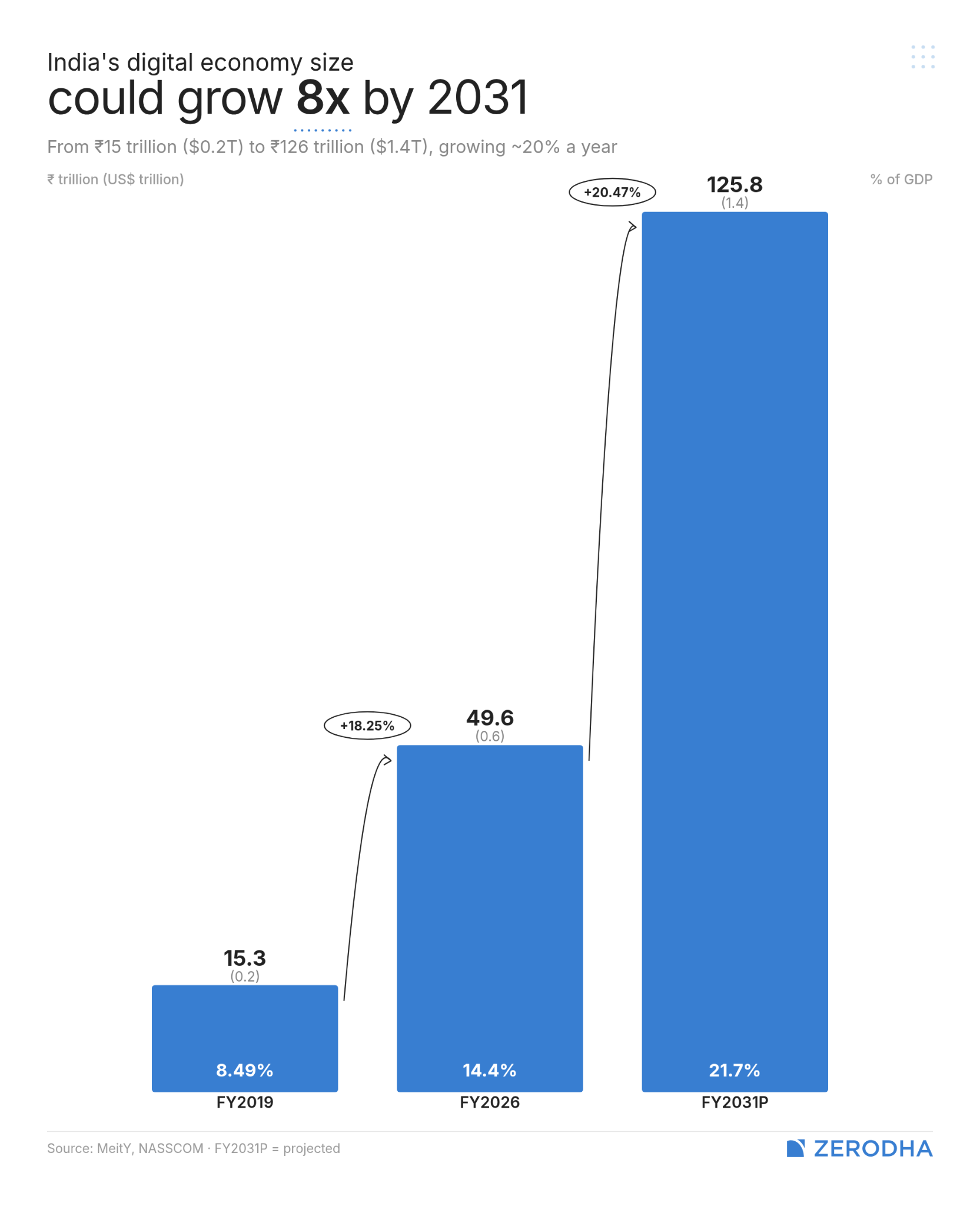
By 2026, that number has moved to 14%, or ₹49.6 lakh crore. On its own, a 5% jump might not sound like much. But it’s worth pausing on what’s actually sitting inside that jump. In this same window, digital wallet users went from 6% of the population to 38%. Government-to-citizen digital services, things like applying for a certificate or accessing a subsidy online, grew 25x. That’s the scale of behaviour change hiding inside what looks, on paper, like a modest shift in a percentage.
Projections for 2031 put the digital economy at ₹125.8 lakh crore, which would mean digital activity accounts for a meaningfully larger share of everything India produces than it does even today.
You can see the same acceleration if you trace how people’s relationship with their phones has changed over the last thirty years, not as a series of distinct eras but as one long, continuous slide from luxury to habit.
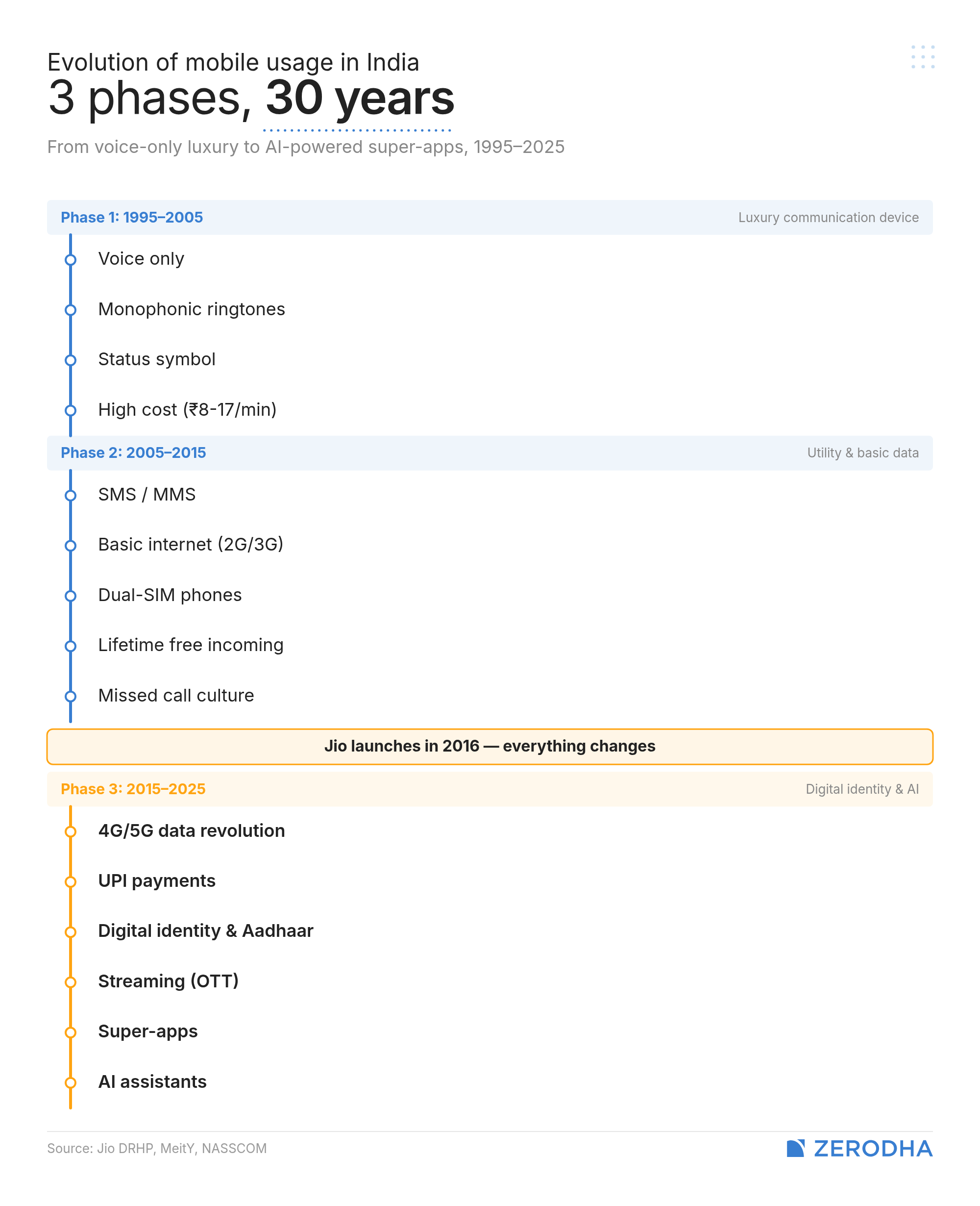
Between 1995 and 2005, owning a phone at all was a luxury: calls could cost anywhere from ₹8 to ₹17 a minute, ringtones were still monophonic, and anything resembling mobile internet was barely usable, let alone common.
The decade that followed, from 2005 to 2015, brought cheap dual-SIM phones and basic 2G and 3G data, and with it a culture built around the missed call, where people treated data as something scarce enough to be used sparingly rather than left running in the background.
It’s really only after 2015 that this changes completely: 4G gives way to 5G, UPI payments become routine, streaming becomes the default way people spend their time online, and data gets cheap and constant enough that nobody thinks about it anymore. That last shift is really what rewired how people in India pay for things, work, and stay in touch with each other.
How data got this cheap
None of this happened on its own, and it’s worth being precise about why. It was Jio’s entry in 2016 that forced the price down, not some industry-wide strategy. Jio priced data so aggressively that the rest of the market had no choice but to match it just to hold on to customers. In 2016, before that shock hit, 1GB of data cost around ₹228, expensive enough that the average Indian used barely 0.2 GB a month.
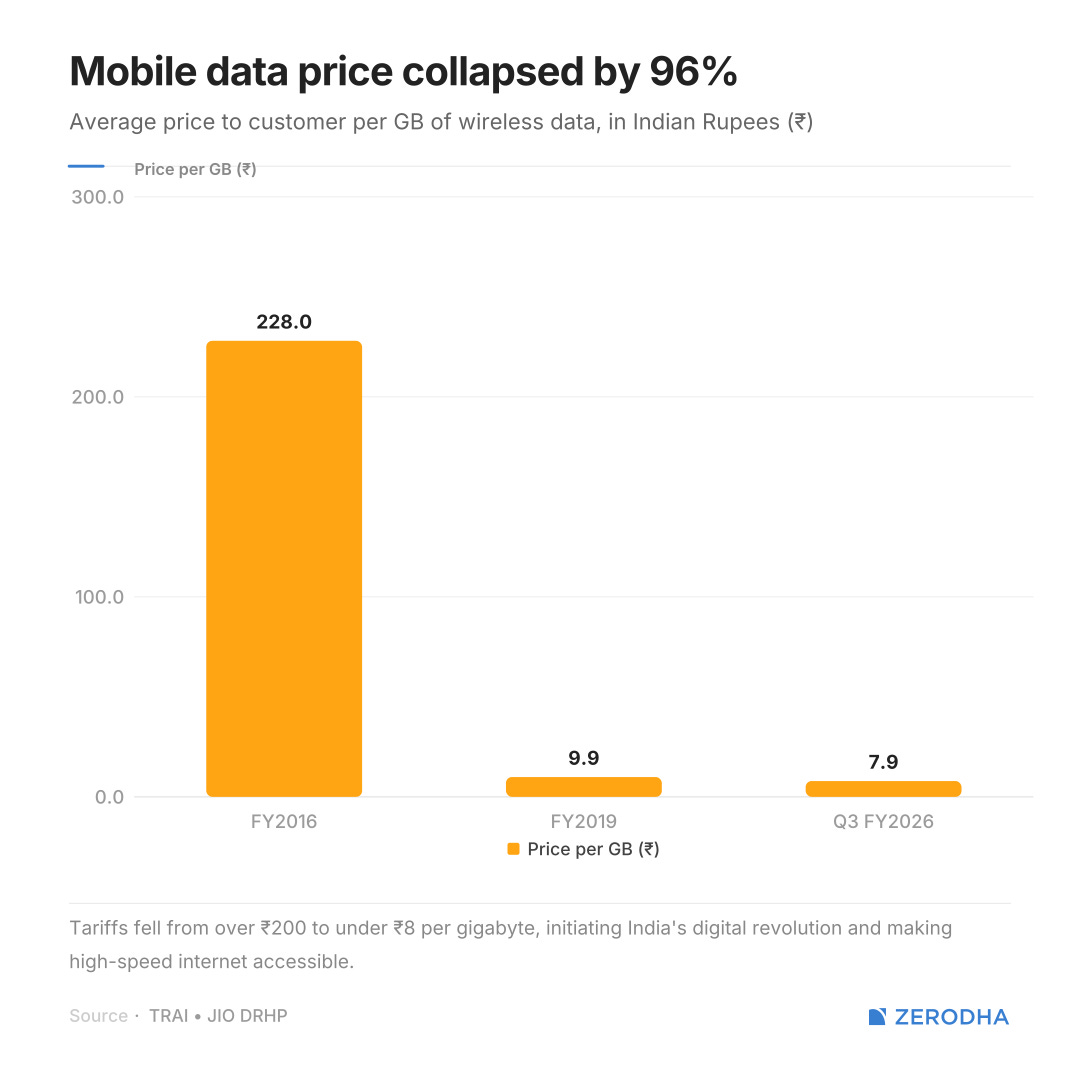
Once the price war that followed Jio’s entry kicked in, that cost fell sharply: by 2019, 1GB cost just ₹9.9, and monthly usage had already climbed to 7.5 GB. Today, in 2026, 1GB costs ₹7.9, and the average user gets through 25.7 GB a month, which is the natural result of data becoming cheap enough that people stop keeping track of how much they’re using and just stay connected.
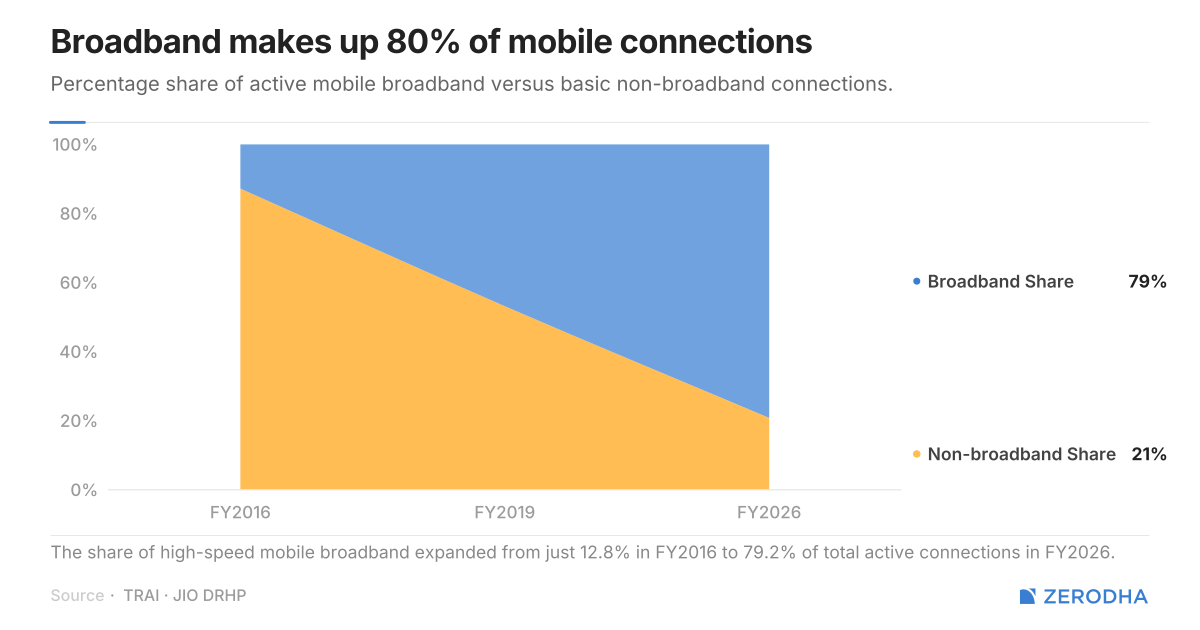
That same shift is visible in how mobile broadband has spread, where mobile broadband simply means a high-speed wireless connection on your phone, as opposed to a basic voice-only SIM with no real data attached.
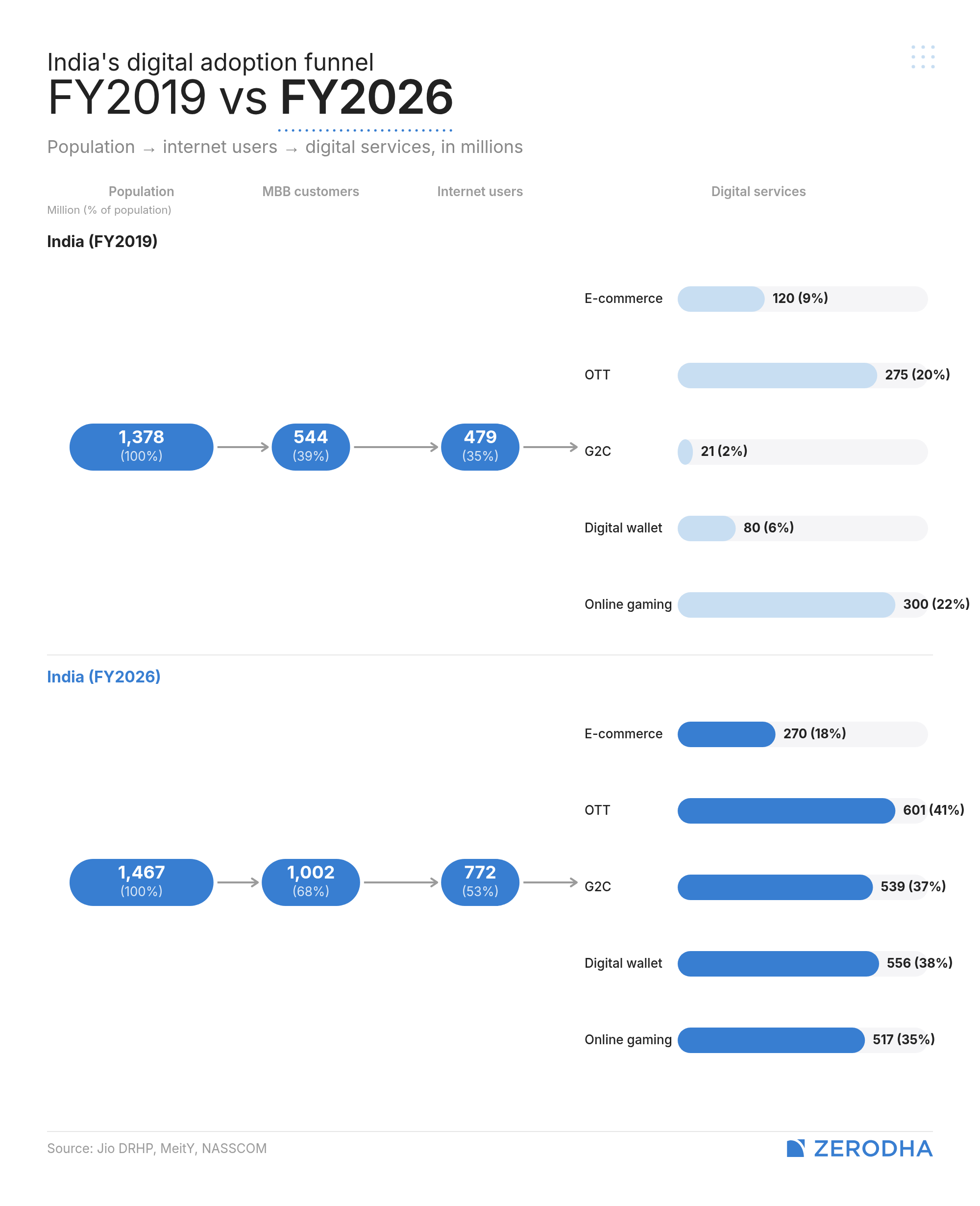
In 2019, only 39% of Indians had a mobile broadband connection; by 2026, that number had climbed to 68%, which works out to over a billion people online. That’s the base everything else sits on top of, from the UPI payments to the government services we just looked at, to the e-commerce we’re about to get into.
Where India still lags compared to the world
India’s absolute numbers look impressive on their own, but they mean more once you remember where the country started. Not long ago, cash on delivery was close to the only way most people would buy anything online, because paying upfront for something that might not show up wasn’t something people trusted.
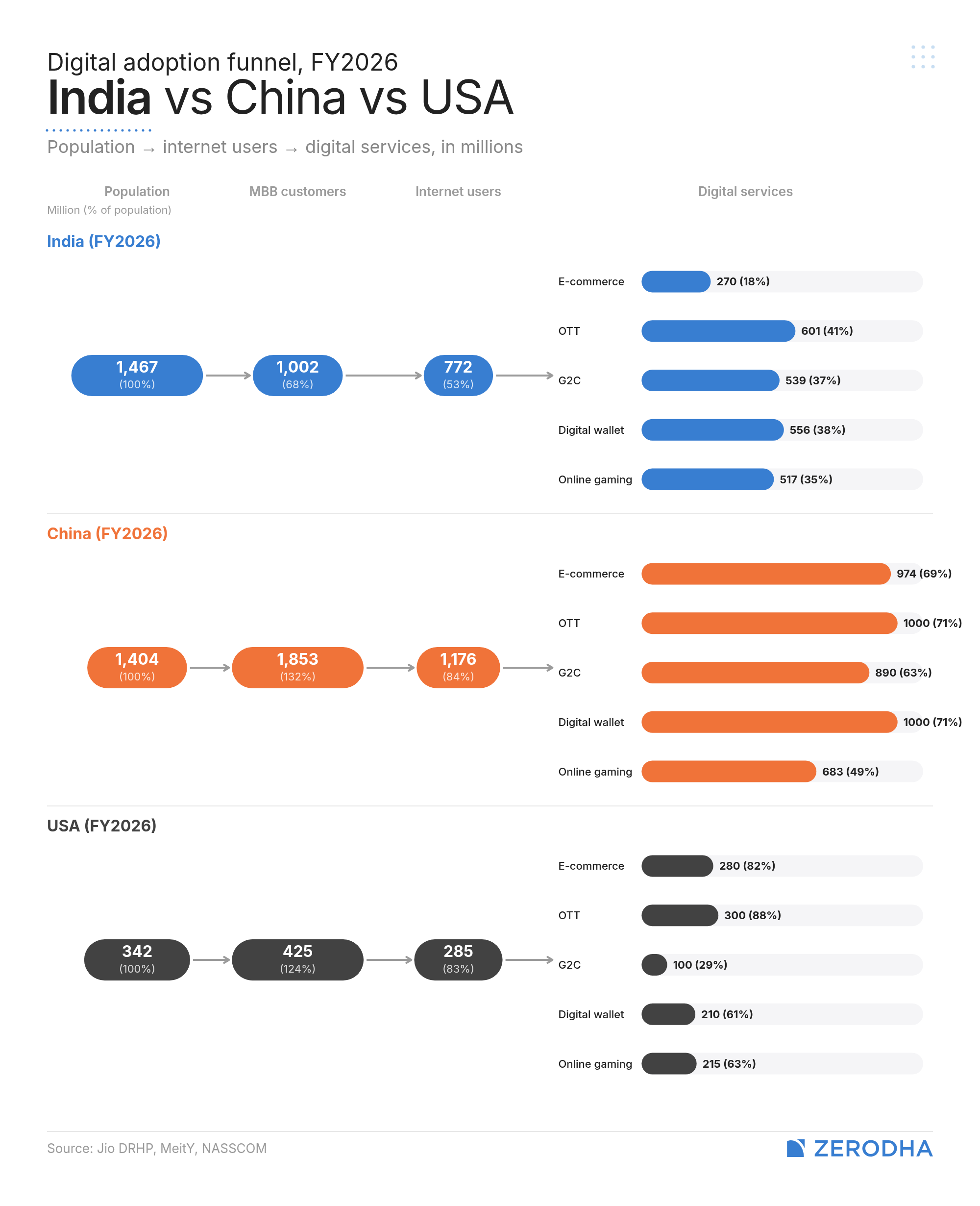
About 41% of Indians use streaming apps, which compares reasonably well to China’s 71% and the US’s 88% once you account for how much lower average incomes are in India relative to those two markets. E-commerce is where the real story is. Only 18% of Indians shop online regularly, against 82% of Americans and 69% of Chinese citizens. That gap is real, but so is the shift behind it: going from a market that ran almost entirely on cash on delivery to one where close to a fifth of the country now pays digitally for what it buys online is genuine progress, even with a long way still to go. The Indian internet today is still used mainly for chatting, watching things, and proving who you are, more than for buying things, and closing that gap is probably the single biggest opportunity left in the market over the next decade.
Part of why India managed to bring so many people online this quickly is that its telecom operators stopped waiting for global technology to fully mature before deploying it themselves. For most of its history, Indian infrastructure trailed the rest of the world by years.
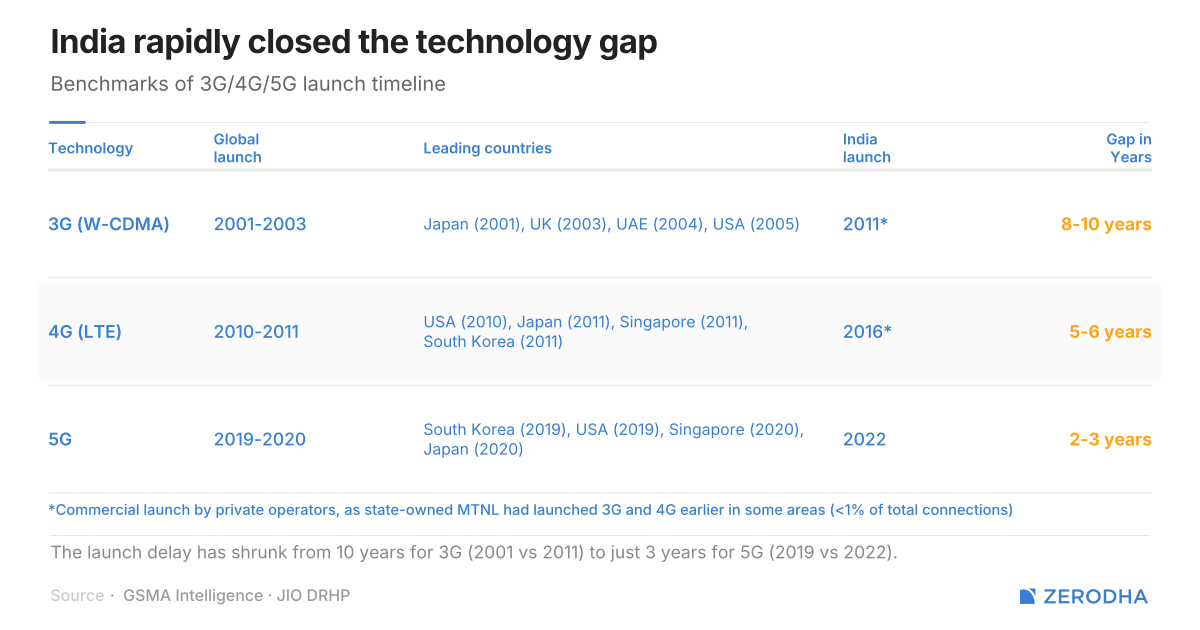
3G, which went global in the early 2000s, took nearly a decade to arrive properly in India, and with 4G that gap had narrowed to five or six years. With 5G, it nearly closed altogether: global rollouts began around 2019 and 2020, and Indian operators had full nationwide 5G networks running by 2022, a lag of just two to three years. That timing matters because it means Indian developers are now building on largely the same generation of network technology as their counterparts in Silicon Valley, even if actual speeds on the ground still have some catching up to do.
How rural India got online
That rapid rollout reshaped who actually uses the internet in India.
Before 4G arrived at scale, broadband access was mostly an urban and upper-income phenomenon, and the numbers from 2019 reflect that.
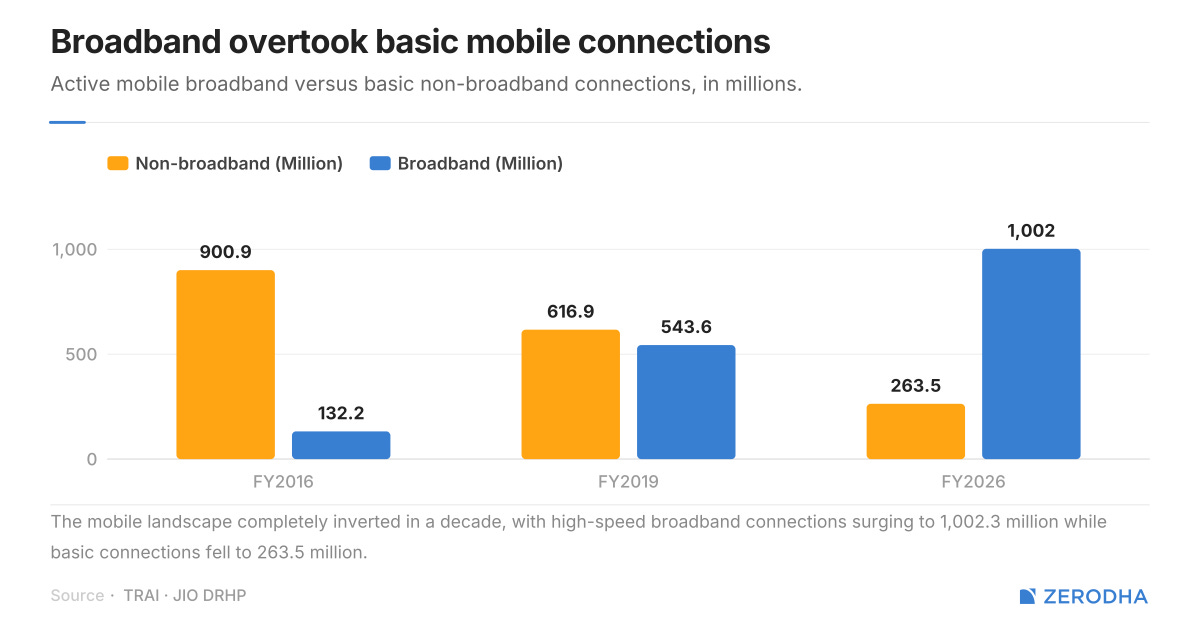
There were 54.3 crore broadband users against 61.6 crore people still on older, voice-only connections, with broadband penetration sitting at just 39%. By 2026, voice-only users had fallen to 26.3 crore, broadband had crossed the one-billion mark, and penetration had climbed past 68%. Looking ahead to 2031, voice-only connections are expected to nearly disappear altogether, with broadband projected to cover 98% of all mobile customers. What that tells you is that future growth isn’t going to come from cities, which are already mostly saturated, but from rural India, which still has real room to grow.
Supporting a billion broadband users who are each burning through 25 GB a month takes an enormous amount of spectrum, which is simply the radio frequency that carries wireless signals through the air. It helps to think of spectrum as a set of lanes on a highway: every telecom company has to buy its own lanes to reach your phone, and if it doesn’t own enough of them, its network slows down and gets congested no matter how good its towers are. This is why telecom wars are actually decided at the spectrum auction, long before any customer notices a difference in their app.
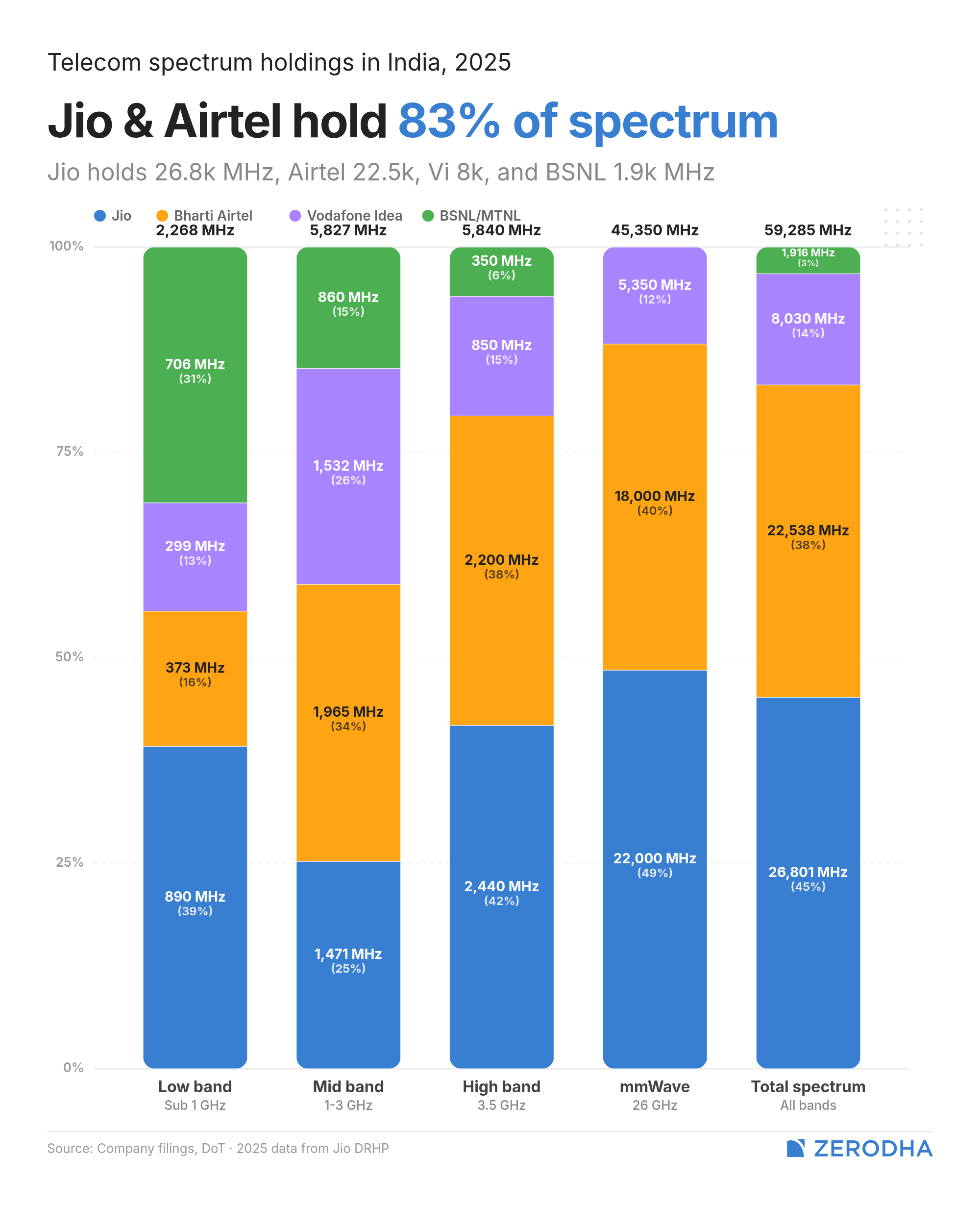
Jio currently holds the largest share of total spectrum, at 45% of the country’s airwaves, with Airtel close behind at 38%.
But the number that matters most strategically is low-band spectrum, which covers frequencies below 1 GHz and travels further while cutting through concrete more effectively, making it the backbone of both indoor coverage in dense cities and long-range reach across rural areas. Jio has cornered 39% of this layer on its own, compared to Airtel’s 16% and Vodafone Idea’s 13%, and that low-band advantage is a significant part of why Jio has ended up leading the market.
The gap in home broadband
Mobile is largely a solved problem at this point.
Home broadband, meaning a fixed internet connection running into a specific house or office rather than something that travels with you, is a completely different story. Of India’s 31.2 crore homes, only 6.36 crore currently have a fixed internet connection, which leaves an enormous and mostly untapped market.
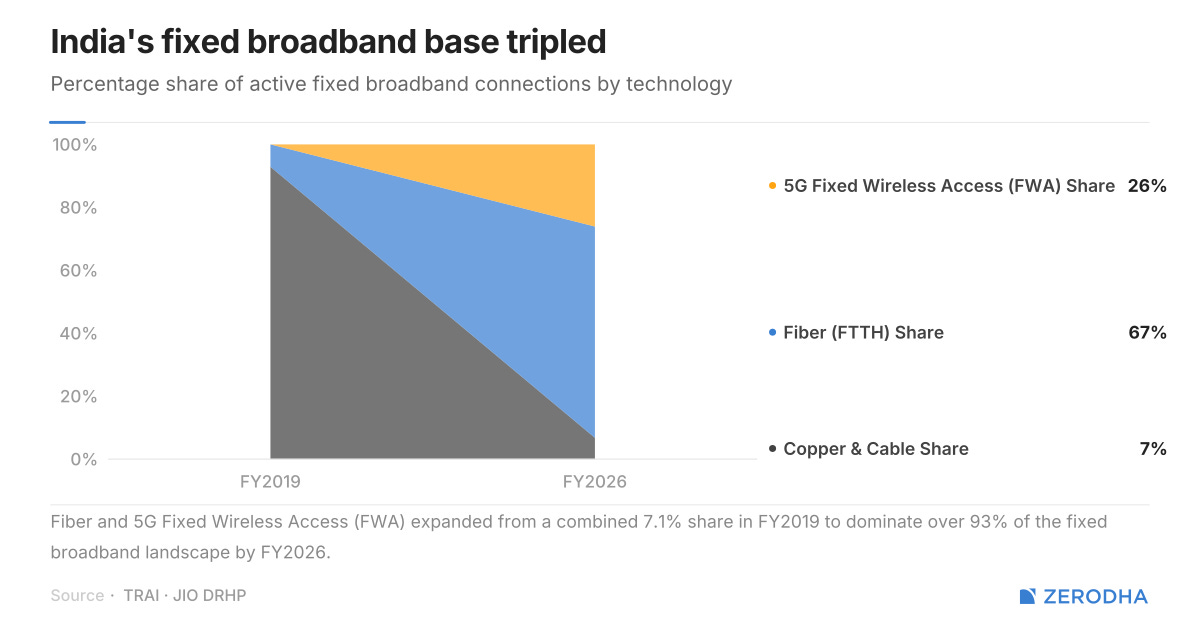
Most of the growth so far has come through fibre, which refers to the physical glass cables buried underground that move data as pulses of light and remain the fastest, most stable way to transmit data that exists today. Fibre connections have grown from 14 lakh homes to 4.27 crore over this period.
But the more significant recent shift has been the arrival of Fixed Wireless Access, or FWA, which exists because digging up roads to lay physical fibre into every individual house is expensive and slow. Instead, telecom companies run fibre to a tower somewhere near your neighbourhood and beam that connection wirelessly to a small receiver mounted on your roof or window, so that it behaves like ordinary home Wi-Fi except for the fact that the last stretch of the journey is wireless rather than cabled.
Starting from almost nothing, FWA already connects 1.66 crore homes
Even accounting for that growth, India’s home broadband penetration sits at only around 20%, which looks small set against the rest of the world. China, South Korea, the UK, and the US all have penetration rates above 100%, meaning more active home connections than actual households, while Brazil, a far more realistic comparison for a market like India’s, sits at 61%. That gap between India and a country like Brazil looks like one of the more promising openings left for Indian telecom, even if the exact economics of capturing it still need to play out.
Comparing Jio, Airtel, and Vodafone Idea
With the price wars largely behind them, Jio and Airtel have built two genuinely different, and genuinely profitable, businesses on top of the same market.
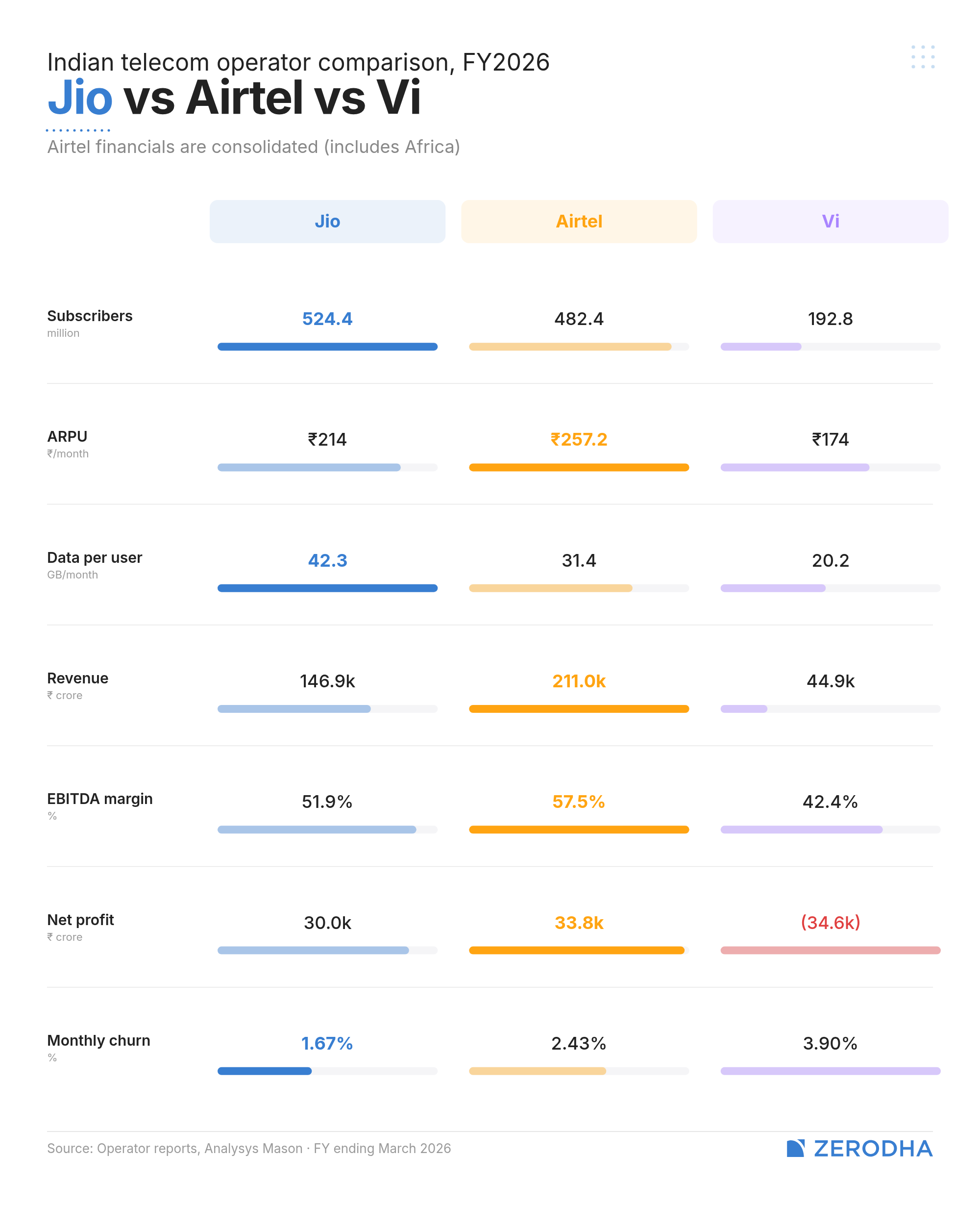
Airtel has leaned into a premium strategy, with a heavier skew toward urban users, postpaid plans, and family bundles, and that shows up directly in its numbers: an India mobile ARPU of ₹257.2 a month against Jio’s ₹214, and ~₹34,000 crore in net profit.
Jio has taken the opposite approach, competing on scale rather than price, carrying 52 crore customers who each use an average of 42.3 GB a month, and converting that sheer volume into roughly ₹30,000 crore in profit.
Vodafone Idea, meanwhile, hasn’t managed to build either kind of advantage: it lost 54 lakh customers over the past year, its ARPU remains stuck at ₹174, and its margins are still underwater, leaving it without the cash to compete with the scale of investment Jio and Airtel are both able to make.
The bottom line
The first decade of India’s digital economy was really about one thing: getting as many people online as cheaply as possible. The next decade looks set to be about something different, home broadband and the margins that come with owning the physical connection into people’s houses. As Jio and Airtel tighten their hold on the residential market through 5G FWA, and as bills across the industry start to drift upward again, the value in this business is likely to keep flowing toward whichever two companies actually own the wires and towers that run into your home.
That’s it for the third edition.
I hope you enjoyed what we’ve put together for you. This is a new format for us, and I fully understand that there are rough edges and plenty of things that can be improved.
And that’s where your end of the bargain begins.
Please send us your feedback, ideas, suggestions, criticisms, and anything else you think can help make this publication better. Unlike many people who say this as a ritual and then promptly ignore what follows, we genuinely do read the comments, emails, and messages we receive.
Points & Figures is still a work in progress, and we’d love your help in shaping what it becomes.
So let us know what you liked, what you didn’t, what you’d like to see more of, and what you’d like us to do differently. We’ll read it all and use it to make future editions more useful, more insightful, and hopefully a lot more fun.
Until next time.
love this series