

Hello, and welcome to this week’s edition of Points & Figures, put together by Kulsum, with a special shoutout to our in-house automobile expert, Vignesh, for sharing his insights.
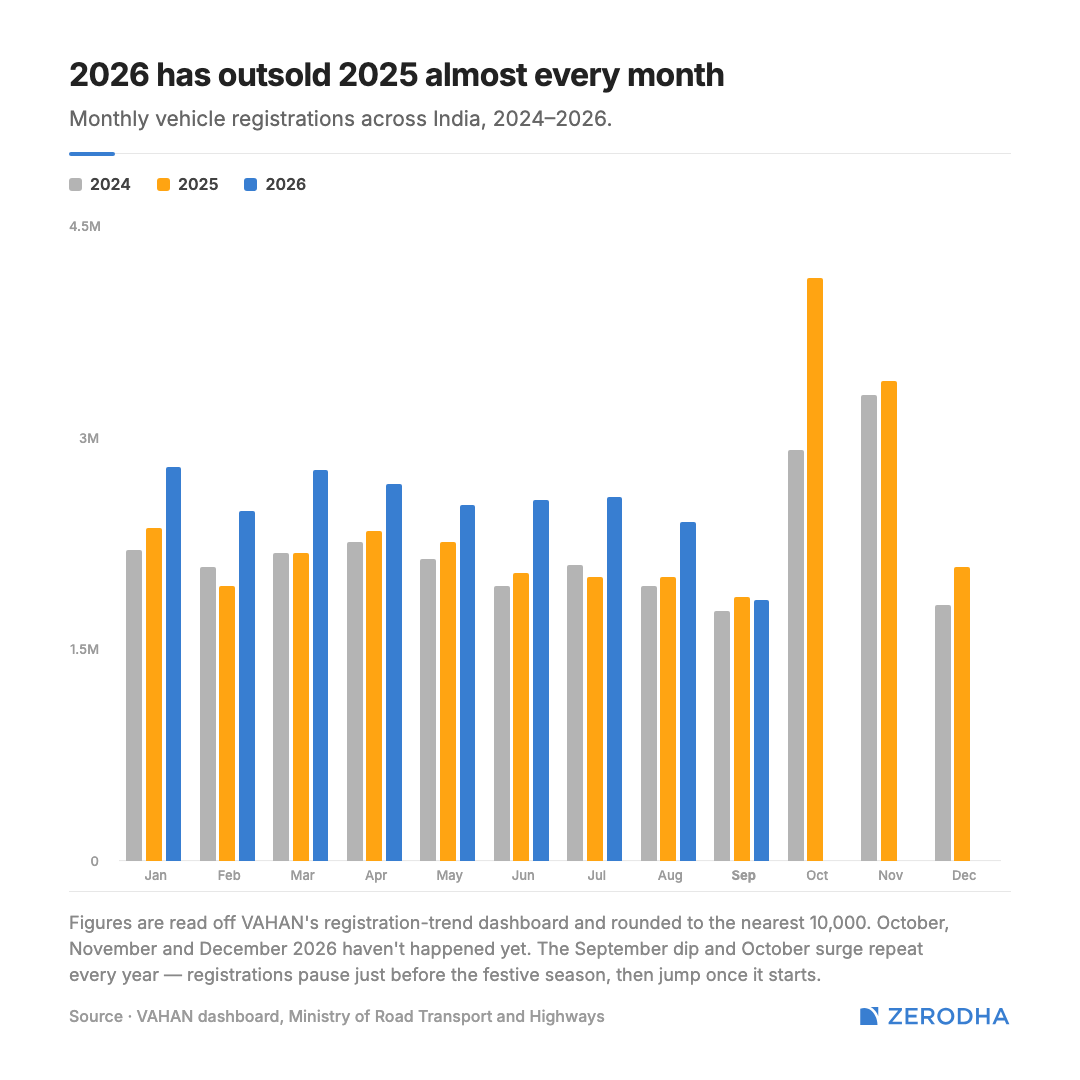
Indians bought more than 24 lakh vehicles in August 2026, the highest ever for that month. That works out to roughly 80,000 new registrations a day. But the total brings together several vehicle markets, each moving at its own pace.
A vehicle is one of the most relatable big purchases an Indian household makes. It can shorten a commute, make a distant job practical, carry children to school or help a driver earn a living. It can also be the household’s first large loan.
The same registration number can therefore mean convenience, aspiration, work or debt, depending on what someone bought and why.
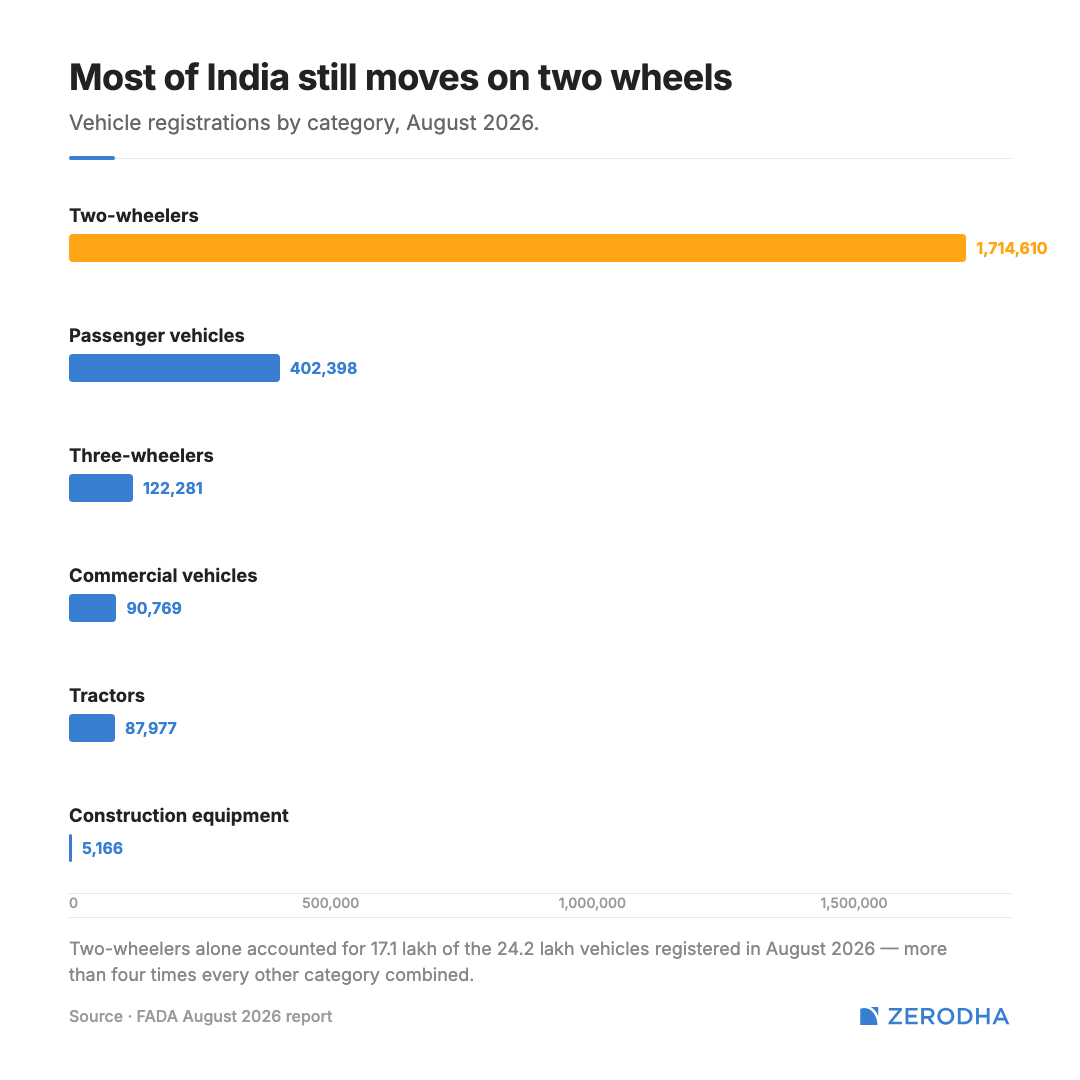
The mix gives us a better sense of what is happening. Of the 24.23 lakh vehicles registered in August, 17.15 lakh were two-wheelers. Passenger vehicles accounted for 4.02 lakh, followed by three-wheelers, commercial vehicles and tractors. A little over seven in every ten registrations had two wheels. We may talk about the Indian vehicle market through car launches, but the motorcycle and scooter remain at its centre.
There is a fairly simple reason for that. An entry-level two-wheeler costs far less upfront than an entry-level car. Both bring recurring expenses such as insurance, fuel or charging, servicing and, if bought on a loan, monthly installments. A car generally costs much more and is harder to park. So a rise in two-wheeler registrations and a rise in passenger-vehicle registrations tell us about different buyers.
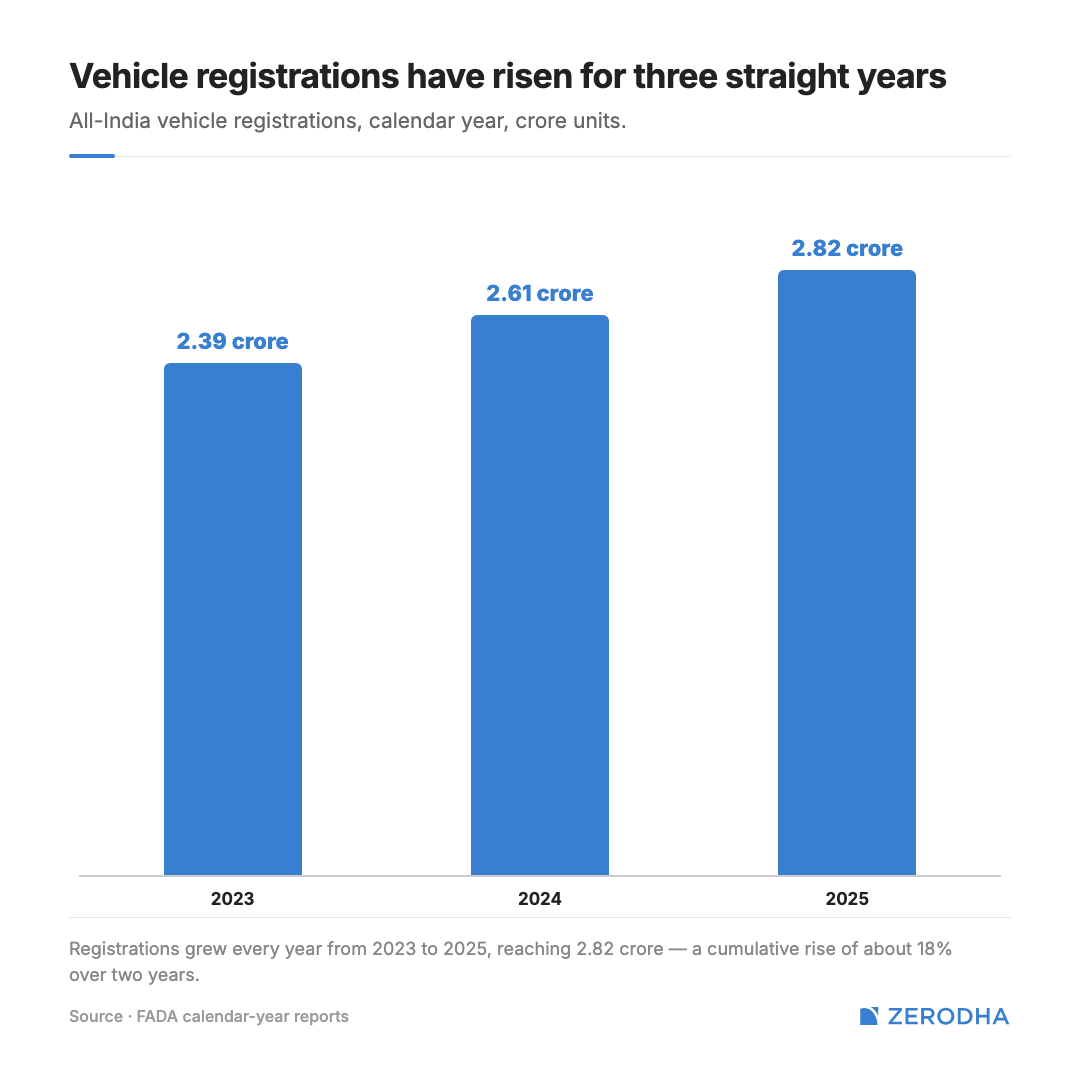
August is part of a longer rise in vehicle sales. FADA, the Federation of Automobile Dealers Associations, tracks retail registrations across dealerships. Its figures show registrations climbing from 2.39 crore in 2023 to 2.61 crore in 2024 and 2.82 crore in 2025.
Passenger vehicles are growing within that larger market. Their retail registrations rose 22.2% year on year during April–August 2026, faster than the 18.1% increase in two-wheelers. But that alone does not tell us that cars have become broadly affordable, or that household incomes have grown at a similar pace. The comparison period made growth look stronger, and a large tax cut had recently helped sales.
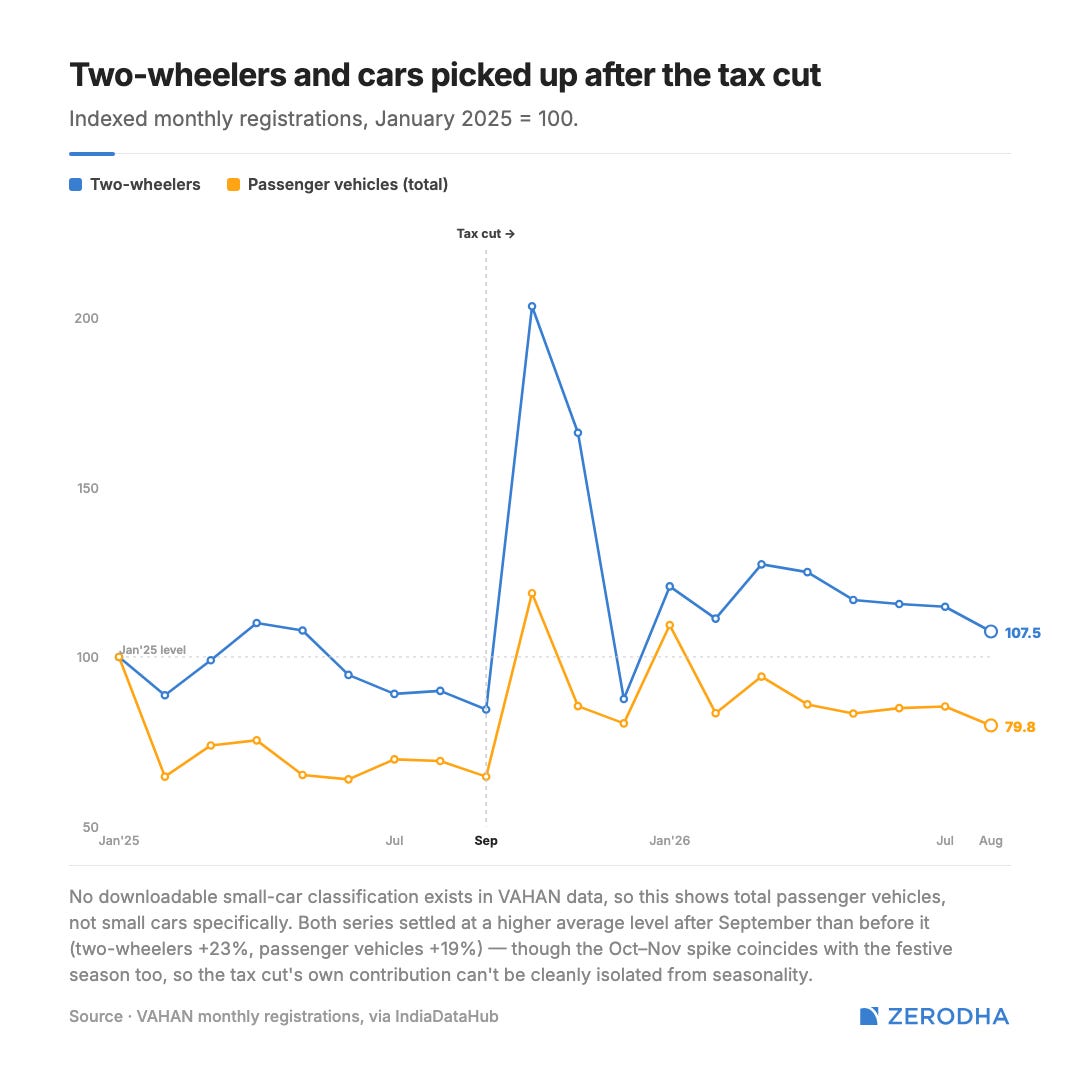
In September 2025, the GST Council cut the tax rate on small cars and motorcycles with engines of up to 350cc from 28% to 18%. Larger sport utility vehicles also saw a lower effective tax burden. The effect showed up in year-end sales: Maruti Suzuki reported an almost 50% jump in small-car sales to dealers in December.
The conclusion is narrower than “India can now afford cars”. Tax cuts made several models cheaper and helped bring forward purchases that people had put off. Even after that relief, a new car remains beyond many household budgets.
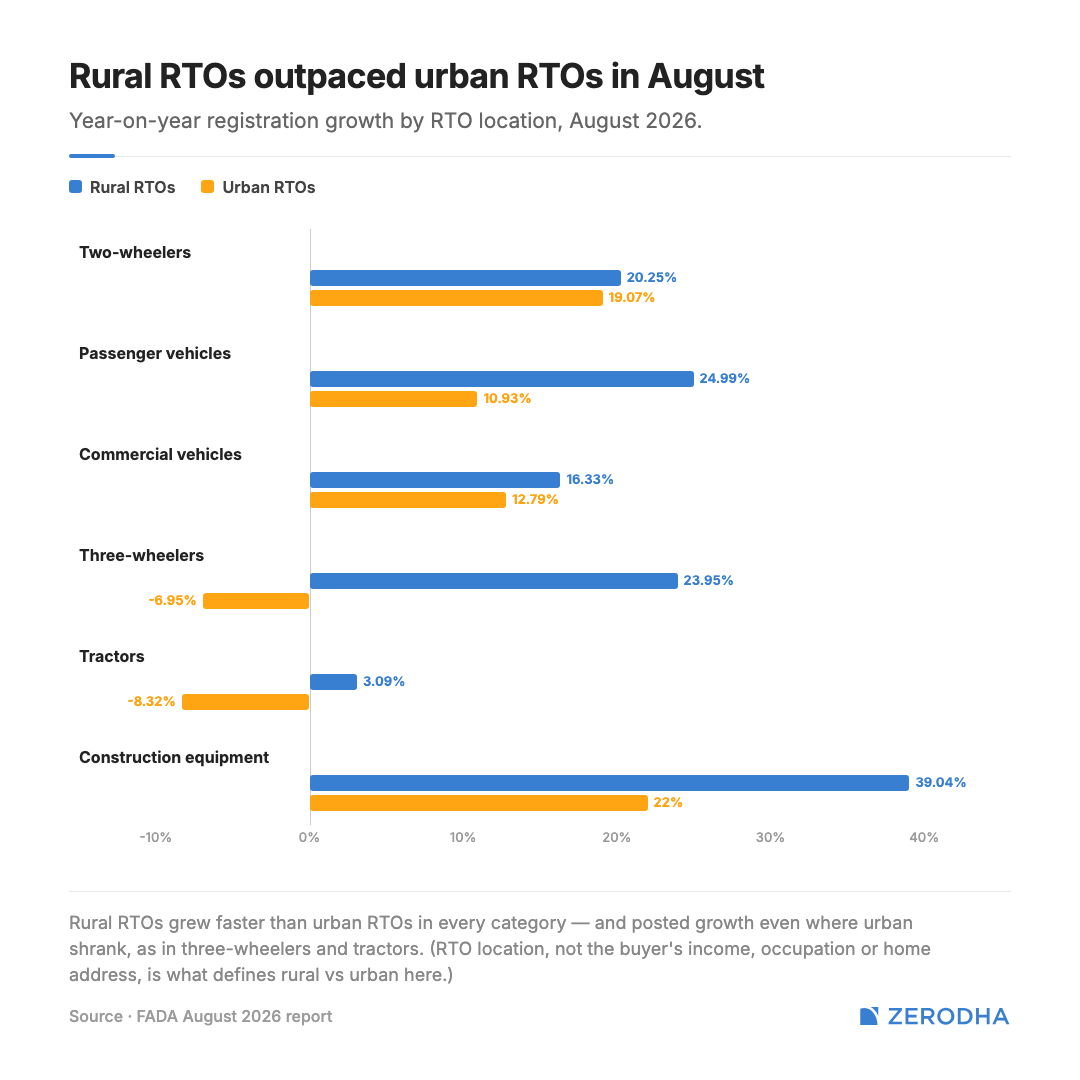
Where those vehicles are being registered is changing too. In August, registrations at rural RTOs grew faster than those at urban RTOs across the major vehicle categories. Rural two-wheeler registrations rose 20.25% year on year, against 19.07% at urban RTOs. The gap was wider for passenger vehicles: 24.99% against 10.93%. Commercial vehicles grew 16.33% at rural RTOs and 12.79% at urban ones.
Those figures need some care. FADA calls a registration rural or urban based on the location of the RTO, not the buyer’s income or occupation. And rural vehicle demand is about more than farming. Two-wheelers, cars and commercial vehicles are all part of it. Tractor registrations were almost flat in August, up just 0.84% year on year, even as the other major categories grew faster at rural RTOs. The figures point to broader demand for mobility, though they do not tell us that every part of the rural economy is booming.
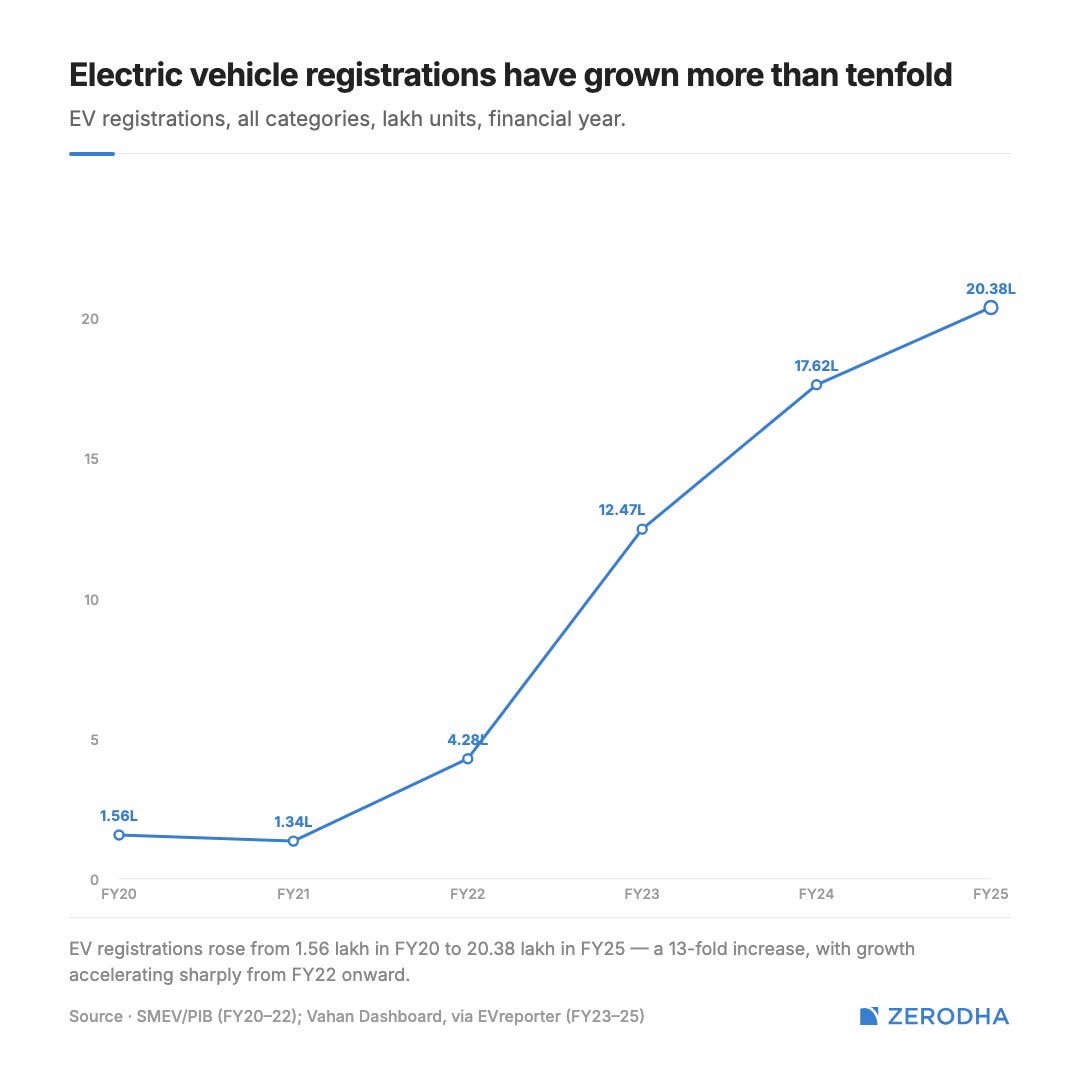
There is another shift alongside where people buy vehicles: what powers them. India’s electric vehicle market has grown large enough that percentage growth from a tiny base no longer tells the whole story. VAHAN data published by the Ministry of Heavy Industries shows annual EV registrations rising from 1.74 lakh in 2019–20 to 4.59 lakh in 2021–22, 11.83 lakh in 2022–23, 16.81 lakh in 2023–24 and 19.68 lakh in 2024–25. EVs went from less than 1% of registrations before the pandemic to 7.5% in 2024–25.
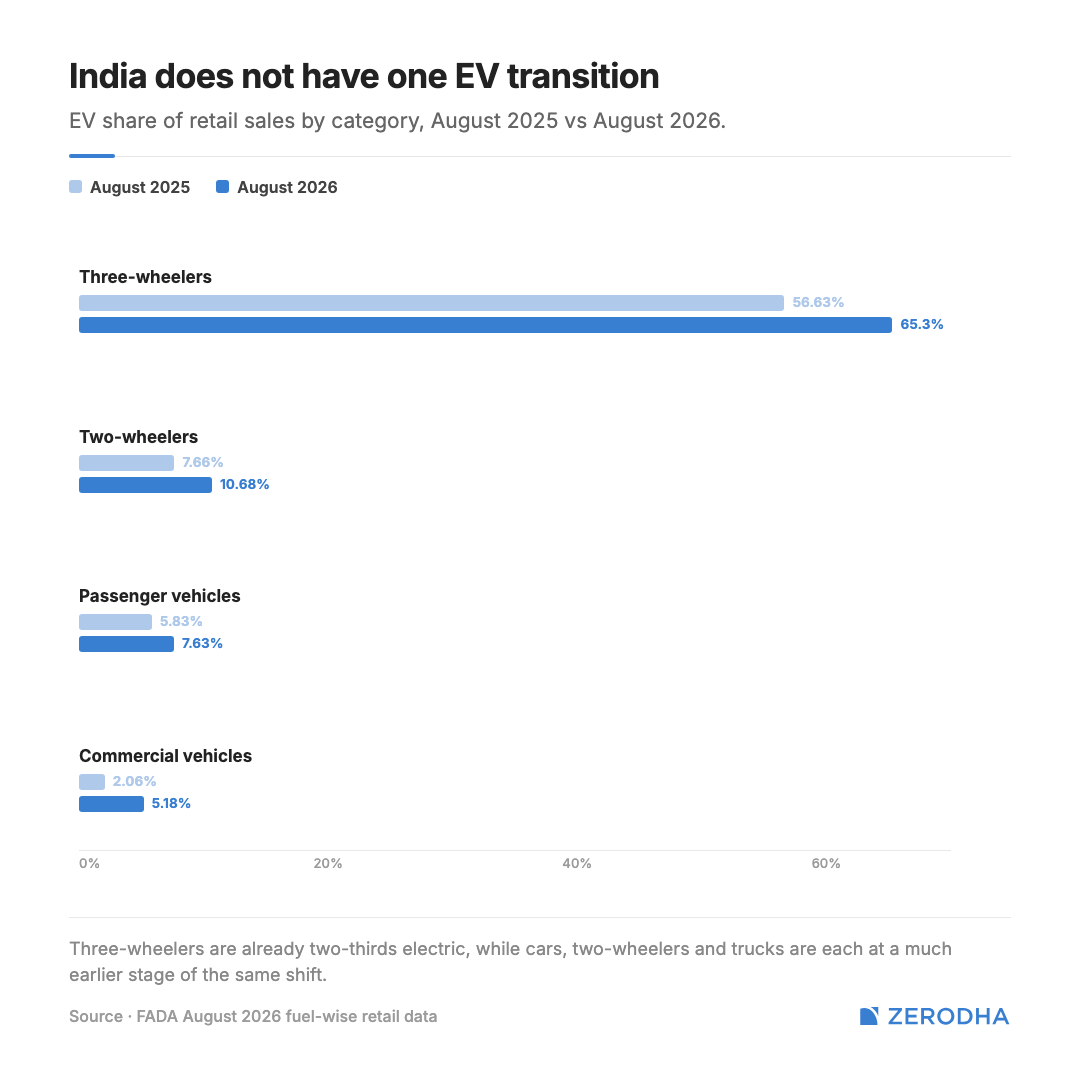
That growth looks very different depending on the vehicle. In August 2026, electric vehicles accounted for 65.3% of three-wheeler registrations, 10.68% of two-wheelers, 7.63% of passenger vehicles and 5.18% of commercial vehicles. A single national EV share hides four quite different markets.
Three-wheelers moved first partly because electric rickshaws already made up a large share of the category. Many three-wheelers are also used to earn a living. When a vehicle travels long distances every day, fuel savings can add up faster than they would for a lightly used private vehicle. But this category is shifting too. Passenger e-rickshaw registrations fell 22% year on year in August, while other passenger three-wheelers rose 23% and goods three-wheelers rose nearly 43%. Electric three-wheelers are no longer just an e-rickshaw story.
Two-wheelers crossed 10% electric penetration in August, while electric passenger vehicles remained below 8%. That gap is not simply a matter of whether buyers like EVs. Purchase price, daily distance, access to home or depot charging, available models and expected resale value all differ across categories. FADA’s figures show us where adoption is happening; they cannot tell us which factor drove each purchase.
The choices are varied even within passenger vehicles. In August, CNG accounted for 25.28% of passenger-vehicle registrations, while EVs had a 7.63% share and hybrids remained a much smaller part of the market. Buyers are spreading across several fuel options, rather than moving in a straight line from conventional cars to electric ones.
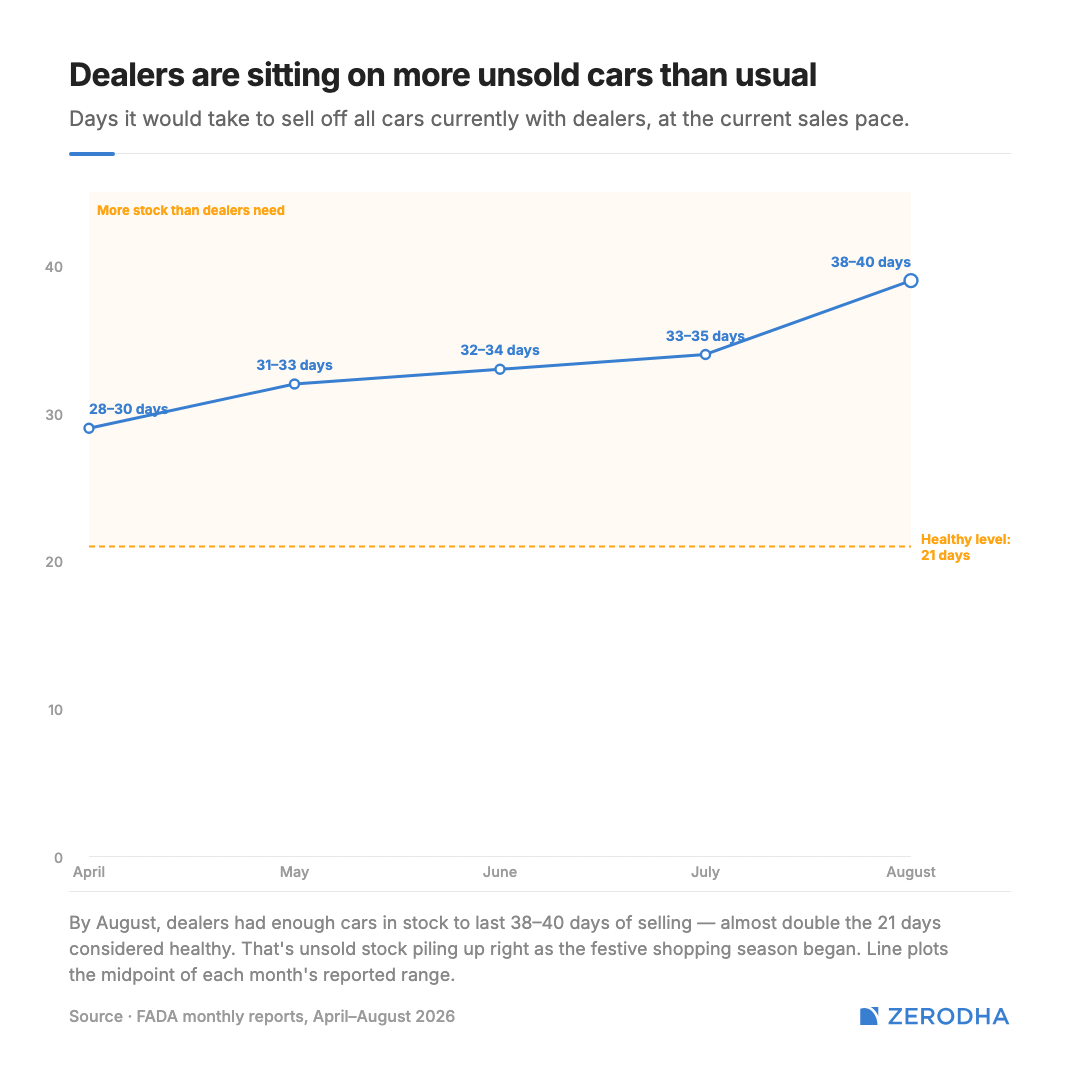
Strong registrations do not mean dealers have nothing to worry about, either. Passenger-vehicle inventory at dealerships rose from roughly 28–30 days at the end of April to 38–40 days by the end of August. FADA recommends 21 days. That does not automatically mean people have stopped buying cars. Dealers tend to stock up before the festive season because they expect sales to rise. But more unsold cars tie up more working capital, leaving dealers more dependent on festive demand meeting those expectations.
India’s vehicle market is growing in several directions at once. Two-wheelers still dominate everyday mobility. Lower taxes have helped passenger-vehicle sales. Registrations at rural RTOs are rising quickly, though nearly flat tractor sales show that rural demand is uneven. EV adoption is growing too, led by three-wheelers, while private cars lag behind.
Behind each trend is someone making a different calculation. One household may be wondering whether a scooter can replace two bus changes. Another may be weighing a car installment against rent and school fees. A three-wheeler driver may be thinking about how much of the day’s earnings will go towards energy. Those decisions are what give the registration figures meaning: a vehicle changes where someone can go, what work they can take and how much the journey costs them.